Why Family Sleep Science Is Worth Getting Right
Sleep is one of those topics where confident-sounding advice spreads fast and sticks hard - even when the research says something different. For families juggling different schedules, age groups, and bedtime battles, that misinformation can quietly undermine everyone's health and mood.
The science on sleep has advanced considerably over the past two decades. Organizations like the American Academy of Sleep Medicine and the American Academy of Pediatrics have published evidence-based guidelines on sleep duration and quality across age groups. What they've found often contradicts widely held assumptions. Understanding the difference between myth and fact won't just help your family sleep better - it can reduce the guilt, stress, and frustration that surround bedtime in many households.
This article is for general informational purposes only and is not a substitute for advice from a qualified healthcare professional. If anyone in your household is struggling with persistent sleep difficulties, consult a doctor or pediatric sleep specialist.
Myth
Everyone in the family needs the same amount of sleep - roughly eight hours works for all.
Fact
Sleep needs change significantly with age. Toddlers need 11-14 hours; school-age children 9-12 hours; teenagers 8-10 hours; and most adults 7-9 hours.
The American Academy of Sleep Medicine publishes age-specific sleep duration recommendations that are widely endorsed by pediatric and adult health bodies. A six-year-old and a forty-year-old have genuinely different biological sleep requirements. Applying one standard to your whole household can lead to undertreated sleep deprivation in children or unnecessary anxiety in adults who naturally sleep less as they age.
Myth
You can fully catch up on lost sleep by sleeping in on weekends.
Fact
Weekend recovery sleep can reduce some short-term fatigue, but research suggests it does not fully restore cognitive performance or repair all effects of accumulated sleep debt.
Studies on sleep restriction find that some cognitive impairments - particularly in sustained attention - persist even after recovery sleep. Regular short-sleeping also disrupts circadian rhythms, making it harder to fall asleep at a consistent time. For families, this means chronic weeknight undersleeping isn't a problem that Saturday morning solves completely.
Myth
A child who has trouble falling asleep probably has a sleep disorder.
Fact
The majority of children's bedtime difficulties are behavioral in origin and respond well to consistent routines and sleep environment adjustments.
Pediatric sleep research consistently finds that bedtime resistance and delayed sleep onset in children most often stem from inconsistent schedules, stimulating pre-bed activities, or conditioned associations (like needing a parent present to fall asleep). True pediatric sleep disorders exist but are less common. A pediatrician can help distinguish between the two - but starting with routine and environment is a reasonable first step.
Myth
Screens before bed are only a problem because of the content kids watch, not the light itself.
Fact
The blue-spectrum light emitted by screens suppresses melatonin production regardless of the content being viewed, which delays sleep onset in both children and adults.
Research on light and circadian biology shows that short-wavelength (blue) light in the evening signals the brain to stay alert by suppressing melatonin release. This effect is independent of whether someone is watching stressful news or a calm nature documentary. Screen time's effects on family health are often debated, but this particular mechanism is well established. Limiting bright screen exposure in the hour before bed is one of the more evidence-grounded sleep hygiene recommendations available.
Myth
Teenagers are just lazy - they don't need to stay up late or sleep in.
Fact
Adolescent biology involves a genuine, measurable shift in circadian timing that makes earlier bedtimes and wake times biologically harder, not a matter of motivation.
Puberty triggers a delay in the circadian phase, meaning teenagers naturally feel alert later in the evening and have difficulty waking early. This is a documented physiological change, not a behavioral choice. The American Academy of Pediatrics has cited this research in advocating for later school start times. Framing teenage sleep patterns as laziness can increase conflict without addressing the underlying biology.
Building Better Sleep Into Your Family's Daily Life
Correcting myths is only useful if it translates to real changes. The good news: most evidence-based sleep improvements don't require expensive products or dramatic lifestyle overhauls. Consistent timing, predictable wind-down cues, and reduced evening light exposure are among the most well-supported strategies across age groups.
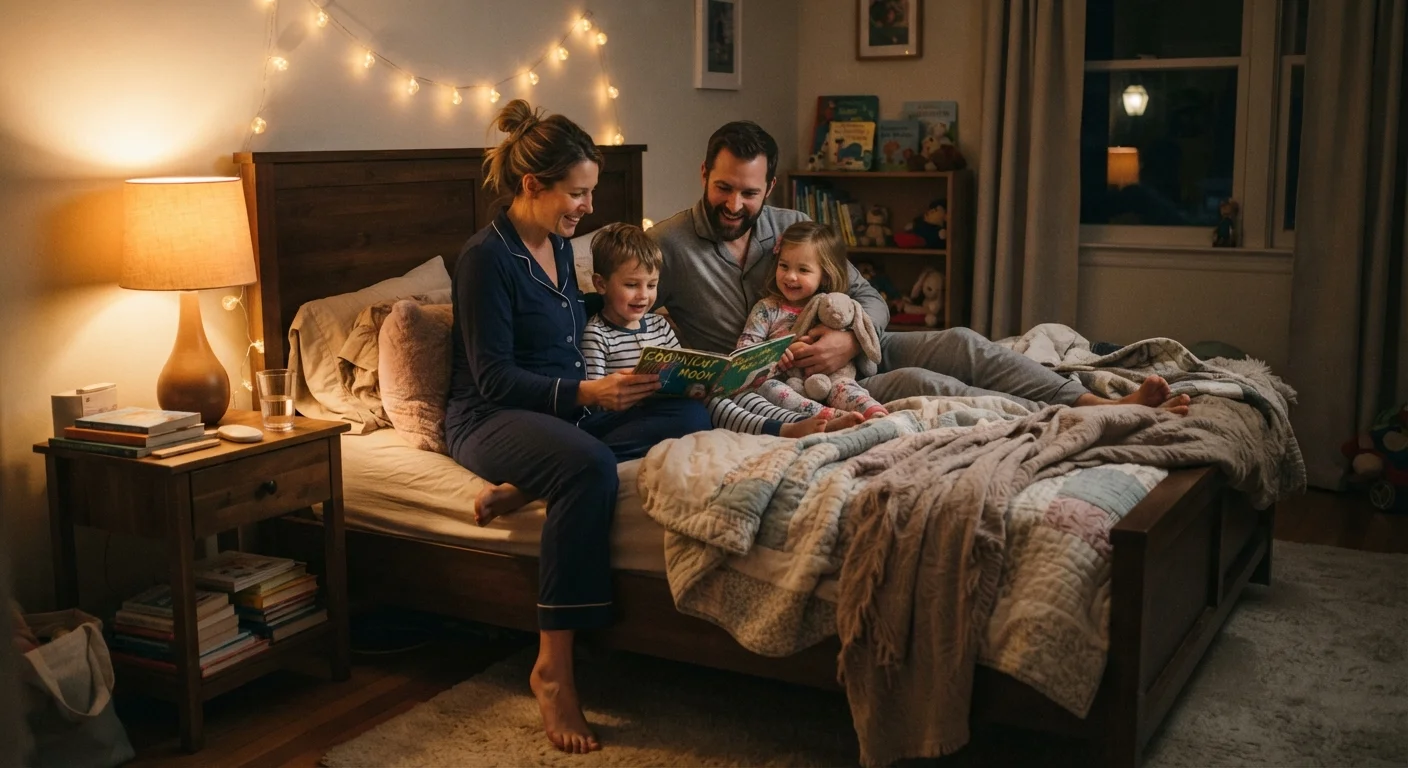
For children especially, a reliable pre-bed routine - the same sequence of events each night - signals the brain that sleep is approaching. Research on behavioral interventions consistently shows these routines reduce bedtime resistance and night waking. See our wind-down routine guide for a practical approach that works for adults too.
Sleep and emotional resilience are tightly linked - a point worth remembering when bedtime friction is making everyone irritable. Getting sleep habits right is as much about daytime functioning as it is about nighttime rest. And if you're working on broader household health habits, our guide to building a family health routine can help you integrate sleep as part of a sustainable system.
When to Seek Professional Guidance
Persistent snoring, gasping during sleep, extreme difficulty waking, or daytime behavioral problems in a child may indicate a medical sleep issue rather than a routine or habit problem. These warrant evaluation by a pediatrician or sleep specialist rather than a home-management approach alone. Do not delay seeking professional advice if symptoms are present.
This article is for informational purposes only and does not constitute medical advice. Always consult a qualified healthcare professional for concerns about sleep health in children or adults.