
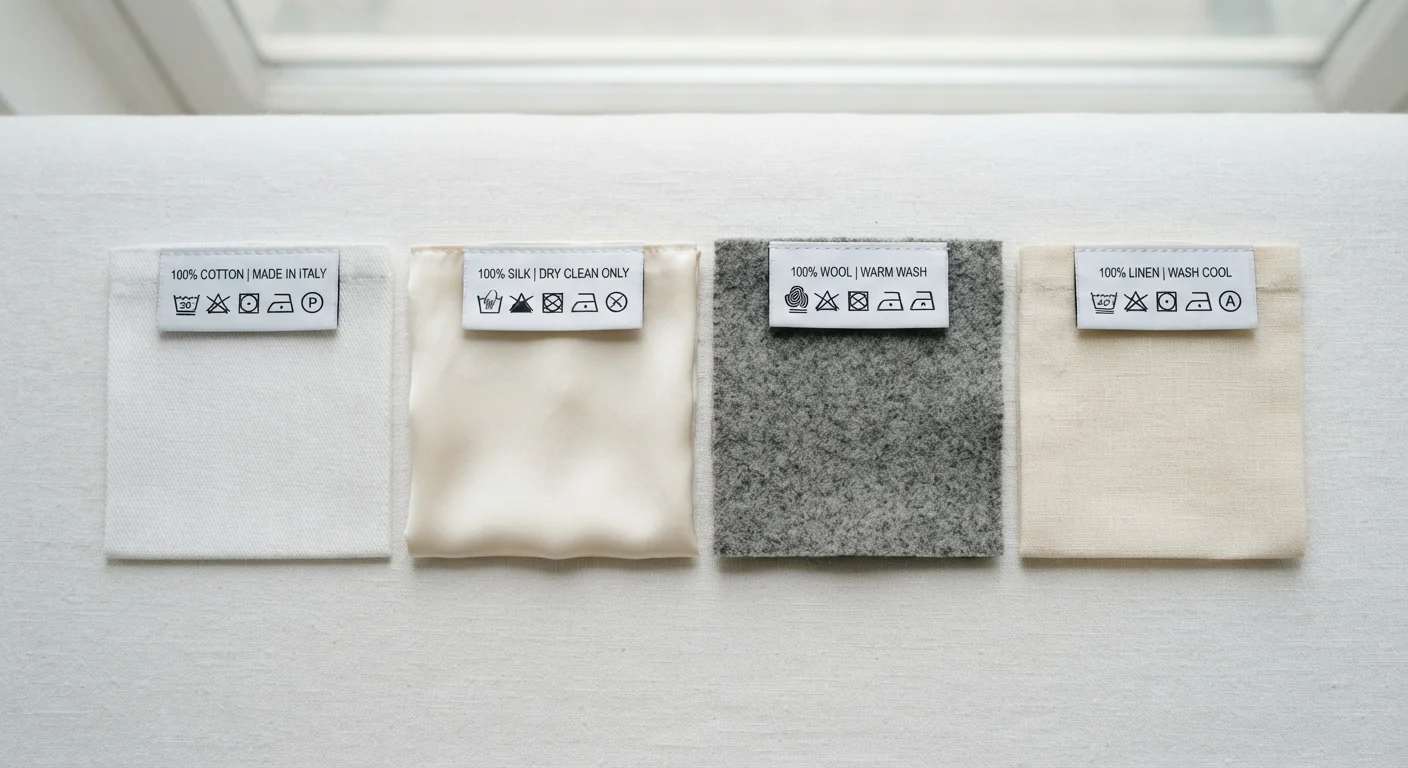
Why Care Labels Actually Matter
That tiny sewn-in tag isn't just an afterthought - it's the manufacturer's tested instructions for keeping a garment in its best condition. Ignoring it is one of the most common (and costly) wardrobe mistakes Americans make. Shrinking a favorite sweater, fading a dark denim jacket, or destroying an embroidered blouse in a hot wash are all avoidable outcomes.
Care labels also connect directly to the idea of getting real value from what you own. The longer a garment holds its shape, color, and structure, the lower its effective cost over time. If you've ever thought about the cost-per-wear of your wardrobe, you already know that preserving what you buy is just as important as buying smart in the first place.
Since 1971, the Federal Trade Commission (FTC) has required U.S. garment manufacturers to attach permanent care labels - and those labels follow an internationally standardized symbol system. Once you learn the symbols, you can read any label quickly, regardless of the brand or country of origin.
| U.S. Care Label Requirement | Mandatory since 1971 (Federal Trade Commission (FTC) Care Labeling Rule) |
| Number of core symbol categories | 5 (wash, bleach, dry, iron, dry-clean) (ASTM D5489 / ISO 3758 international standard) |
| What an X through a symbol means | Do not perform that action (Universal care label convention) |
| Dots on temperature symbols | 1 dot = cold, 2 = warm, 3 = hot (Standard across U.S. and international labels) |
| Line(s) beneath a wash symbol | Use a gentler cycle (1 line = permanent press, 2 lines = delicate) (ASTM D5489 standard) |
| Dry-clean solvent codes | P = perchloroethylene safe; F = petroleum solvent; W = wet-clean (ISO 3758 dry-cleaning symbol system) |
The Five Core Symbol Categories
Every care label draws from five symbol families. Here's what each one means at a glance:
Wash symbol
A bucket or tub icon representing water washing. Dots inside indicate water temperature (one dot = cold, two = warm, three = hot). A hand in the tub means hand-wash only.
Bleach symbol
A triangle. An empty triangle means any bleach is acceptable. A triangle with two diagonal lines means only non-chlorine (oxygen) bleach. An X through the triangle means do not bleach.
Tumble dry symbol
A square with a circle inside, representing a dryer drum. Dots inside indicate heat level. An X through it means do not machine-dry - air-dry instead.
Iron symbol
An iron icon. Dots indicate heat level: one dot = low (synthetics), two dots = medium (wool), three dots = high (cotton/linen). An X means do not iron.
Dry-clean symbol
A circle. A letter inside (P, F, W) tells the dry cleaner which solvent is safe. An X through the circle means do not dry-clean.
Natural drying symbol
A square without a circle, with lines inside indicating how to air-dry. A single vertical line means hang to dry; three horizontal lines mean lay flat; diagonal lines mean dry in shade.
Felting
An irreversible process where wool or animal fibers mat together due to heat, moisture, and agitation. Felted wool cannot be restored to its original texture.
Delicate / gentle cycle
A machine-wash setting that uses slower agitation and lower spin speeds to reduce stress on fragile fabrics. Usually indicated by a wash symbol with one or two lines beneath it.
Within each category, the number of dots signals temperature intensity, and a hand symbol inside an icon means the task should be done by hand - gently. A line beneath a symbol means use a gentler setting. Two lines means the most delicate setting available. An X through any symbol means do not perform that action.
For example: a bucket with a single dot means wash in cold water; a bucket with two dots means warm; three dots means hot. A bucket with an X means do not wash with water at all - typically dry-clean-only items like structured blazers or beaded gowns.
This symbol language is part of a broader consumer literacy skill set. Just as reading a price tag reveals hidden information, reading a care label gives you factual data manufacturers are required to provide - you just need to know the code.
Fabric-Specific Tips That Go Beyond the Label
Labels tell you the minimum - but knowing a bit about your fabric helps you make smarter judgment calls when the label is faded or missing.
When the Label Is Missing or Faded
If a care label has worn off, check the fiber content listed on any remaining tag - that alone gives you a strong starting point. As a general rule of thumb when uncertain, default to cold water, gentle cycle, and air-drying: this combination is safe for the vast majority of fabrics and is unlikely to cause damage. When in doubt on a high-value or delicate piece, professional dry-cleaning is a reasonable precaution.
- Cotton: Generally machine-washable, but prone to shrinkage in hot water. Wash in cold and air-dry or tumble dry low to maintain sizing.
- Wool and cashmere: Cold water hand-wash or dry-clean only. Lay flat to dry - never hang, which distorts the shape. Avoid agitation, which causes felting (irreversible matting).
- Silk: Delicate protein fiber; even approved machine-washing should use a mesh laundry bag. Cool water only. Skip the dryer entirely - air-dry away from direct sunlight.
- Polyester and nylon: Generally durable and machine-washable, but high heat can cause pilling and fabric breakdown over time. Low-to-medium heat is safer.
- Linen: Can handle machine-washing but wrinkles significantly. Remove promptly from the washer and lay flat or hang immediately.
- Rayon/viscose: Often labeled hand-wash or dry-clean only. It weakens considerably when wet and can shrink or lose shape permanently in a machine.
Building a wardrobe you can maintain confidently is a key part of dressing well on any budget - because clothes you can't care for properly don't stay in rotation long.