
What a Price Tag Is Actually Communicating
A price tag is a retailer's opening statement, not a neutral fact. It tells you what the seller wants to receive - and it's designed with presentation choices that influence your perception of value. Understanding those choices is the first step toward smarter spending.
Three elements appear on nearly every tag: the selling price, sometimes a "regular" or "compare at" price, and occasionally a per-unit breakdown. Each one carries information, but also deliberate omissions. The selling price tells you nothing about durability, total ownership cost, or whether the same item sells for less elsewhere. The "compare at" price uses a psychological principle called anchoring - presenting a higher number first so the actual price feels like a win, regardless of whether the original price was real or commonly charged.
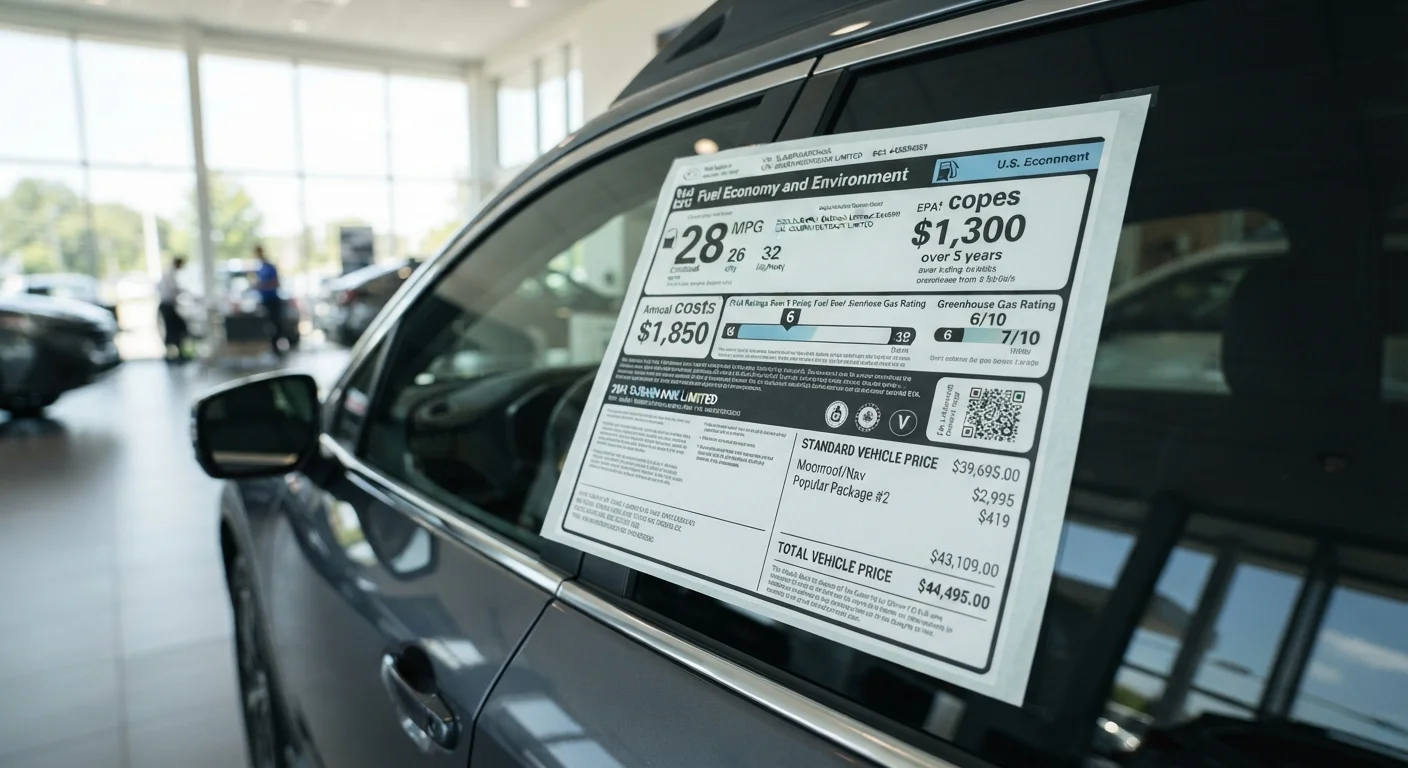
For a deeper look at how this same dynamic plays out in a major purchase, see Reading a Window Sticker: What the Numbers Really Mean, which breaks down a more complex version of the same labeling challenge.
What you will need
How to Evaluate Any Price Tag in Five Steps
The steps below apply to groceries, clothing, electronics, and most everyday consumer goods. They take under a minute per item once the habit is formed.
Find the unit price - not just the selling price
Most grocery and big-box retailers are required to display a unit price on the shelf label - typically expressed as a cost per ounce, per count, per fluid ounce, or per square foot. Locate this smaller figure and use it as your primary comparison metric, not the large selling price.
If no unit price is displayed, divide the selling price by the quantity (weight, count, or volume) yourself. A $4.50 bottle containing 30 fl oz costs $0.15/fl oz; a $3.20 bottle containing 16 fl oz costs $0.20/fl oz. The larger, pricier item is actually cheaper per unit.
Calculate cost-per-use for non-consumables
For items you'll use repeatedly - clothing, appliances, tools - divide the selling price by a realistic estimate of how many times you'll use the item. This produces a cost-per-use figure that makes long-term value visible in a way the sticker price never does.
A $120 blender used four times a week for two years has a cost-per-use under $0.29. A $40 blender that breaks after three months has a cost-per-use several times higher. The sticker price alone inverts the actual value comparison.
Interrogate the "was" price
When a tag shows a crossed-out or "regular" price alongside a sale price, ask two questions: Was this item actually sold at that higher price in a meaningful volume? And for how long? Retailers are not always required to disclose the duration or frequency of the original price.
If you're uncertain, search the item online to check its typical price range across multiple sellers. A "40% off" tag that reflects an inflated baseline is no discount at all.
Account for total ownership cost
The price tag covers acquisition - not ownership. Batteries, replacement filters, subscription access, installation, alterations, cleaning requirements, and maintenance costs can substantially change what a product actually costs you over time.
Before completing a purchase, ask: Does this item require ongoing spending to function? Does it need professional servicing? Are replacement parts expensive or difficult to find? Factor your best estimates into the effective price.
Make the decision based on value, not price
Once you have the unit price, cost-per-use, true sale savings, and estimated ownership cost, you're equipped to judge value - which is the ratio of benefit to total cost, not simply the number on the tag. A lower-priced item that underperforms or wears out quickly delivers poor value. A higher-priced item that lasts, functions reliably, and requires no upkeep may cost less in every meaningful sense.
Value is always relative to your actual usage patterns and needs. An item that represents great value for someone who uses it daily may represent poor value for someone who will use it once.
Use Your Phone's Calculator Every Time
Unit price math takes under 30 seconds with a calculator. Making this a consistent habit - rather than an occasional one - compounds into meaningful savings across thousands of purchases over the years. The effort-to-benefit ratio is among the highest of any consumer skill you can build.
Common Traps and How to Avoid Them
Even informed shoppers encounter labeling patterns designed to complicate comparison. Here are the most common ones.
- Pack-size manipulation: A product reformulated into a slightly smaller package at the same price is a quiet price increase. Unit pricing exposes this immediately.
- "Sale" tags on items that are always on sale: Some retailers permanently display a crossed-out price. If a product is never sold at that "original" figure, the discount is not meaningful.
- Bundle pricing: "3 for $5" deals only save money if you would have bought three anyway. Buying two at the regular price may cost less total.
- Quality signals in the price: Higher prices do not reliably indicate higher quality. Price often reflects brand positioning, packaging, or marketing spend - not product performance.
These same omission tactics appear across categories. Why the Cheapest Option Isn't Always the Best Value explores how low prices can obscure hidden costs just as effectively as inflated ones.
The Price Tag Leaves Out Hidden Costs
No price tag is required to show you ongoing costs, quality indicators, or total lifetime value. These omissions aren't accidental - they make the initial price appear more favorable. Building the habit of asking what the tag doesn't show is the single most effective shift a consumer can make.
Urgency Language Is a Pressure Tactic
Tags or signs reading "Today Only," "Limited Stock," or "Ends Sunday" are designed to compress your decision-making time. Shortened deliberation benefits the seller, not you. If a deal disappears before you can think clearly about it, the loss is usually smaller than the cost of a poor purchase made in haste.
Applying These Skills Beyond the Grocery Aisle
Price-tag literacy transfers across every category. In fashion, the sticker price rarely tells the full story. A $30 garment worn twice costs $15 per wear; a $90 garment worn 60 times costs $1.50. This is the cost-per-wear framework - a practical way to reframe clothing purchases. Our Cost-Per-Wear: The Math Behind Smarter Clothing Choices walks through the calculation in detail.
For clothing care - which directly affects cost-per-wear - Clothing Care Labels Decoded explains what those washing symbols actually mean, so purchases last longer. And if you apply similar label-reading habits to food shopping, The Nutrition Label Decoded provides the same structured approach for nutrition facts.
Reading price tags critically is ultimately a form of financial literacy - one that compounds over hundreds of small decisions each year. It doesn't require expertise; it requires a brief pause and a set of consistent questions.
This article provides general consumer education and is not personalized financial advice. For decisions involving significant financial commitments, consider consulting a qualified financial professional.