Why Smart Homes Needed a Common Standard
Before Matter, building a smart home often felt like assembling a puzzle where the pieces came from different boxes. A smart plug from one brand might refuse to work with a voice assistant from another. A hub required for one ecosystem could be incompatible with a competing product line. Consumers either locked themselves into a single brand's ecosystem or spent hours troubleshooting compatibility issues.
This fragmentation was the central problem Matter was built to solve. Launched publicly in late 2022, Matter is an open-source, royalty-free connectivity standard developed by the Connectivity Standards Alliance (CSA) - an industry body that counts Apple, Google, Amazon, Samsung, and hundreds of other companies as members. The idea is straightforward: agree on a common set of rules devices must follow, and cross-brand compatibility becomes the default rather than the exception.
For a broader foundation on how connected devices work in a typical home, see our plain-language smart home explainer.
600+
Companies in the Connectivity Standards Alliance
The CSA, the body that governs the Matter standard, counts over 600 member companies including major platform holders and device manufacturers.
4,000+
Matter-certified devices available
As of mid-2024, the CSA's product registry listed over 4,000 Matter-certified products across device categories including lighting, locks, sensors, and thermostats.
What Matter Actually Does (and Doesn't Do)
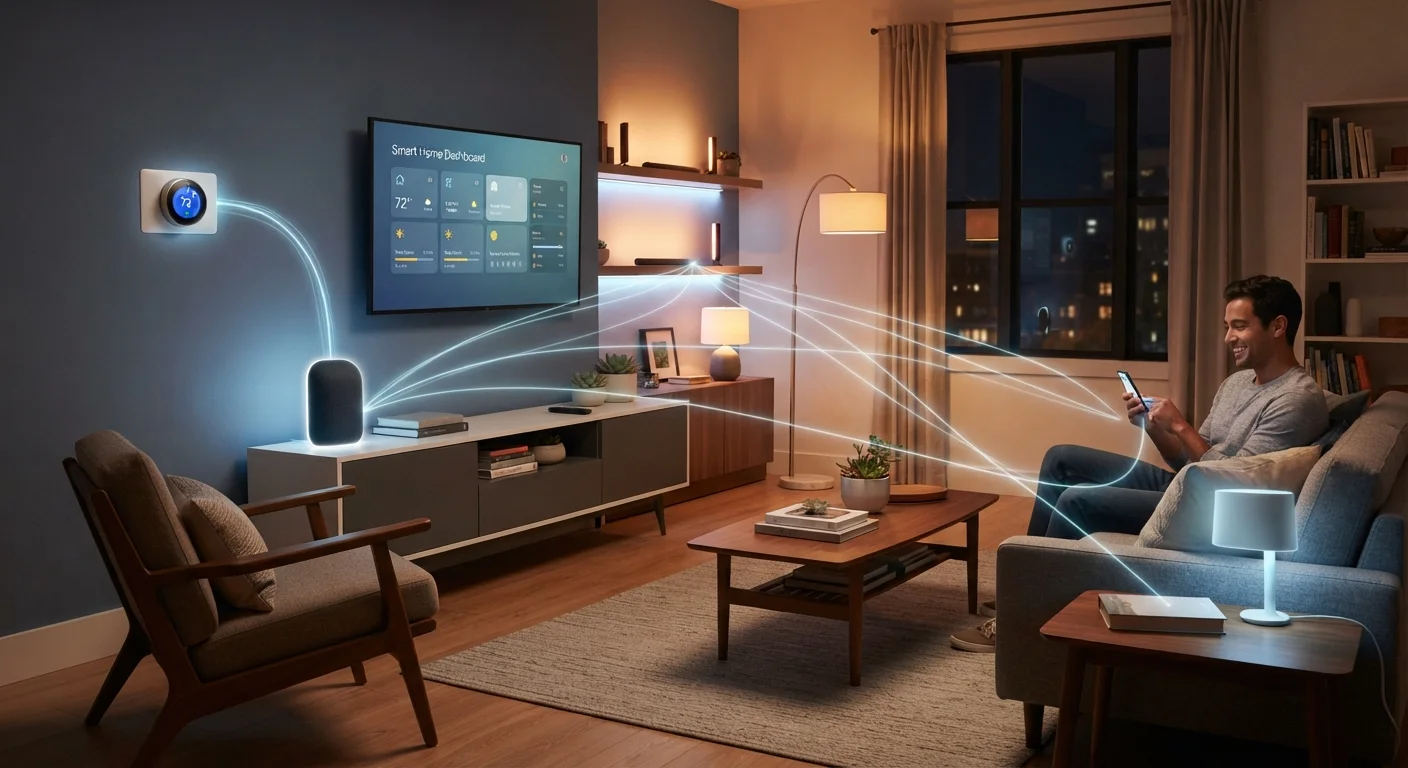
Matter defines how devices discover each other, how they authenticate (prove they're trustworthy), and how they exchange commands - all locally, over your home network. Critically, this local-first design means your smart light switch can respond to a command even if your internet connection drops momentarily.
What Matter does not do is replace your apps, voice assistants, or cloud services. When you ask your voice assistant to dim the living room lights, Matter handles the handshake between the assistant's hub and the light - but the app you use to set schedules and the voice assistant that processes your command remain brand-specific. Matter is the infrastructure layer, not the interface.
It also doesn't guarantee that every feature of every device works across every platform. A manufacturer may support Matter for basic on/off and brightness control but keep advanced features - like custom scenes or energy monitoring - locked to their own app. Reading the device's Matter certification details helps clarify what's covered.
Check the Matter Logo Before Buying
When shopping for new smart home devices, look for the Matter logo on packaging or in product specifications. This logo indicates the device has passed official CSA certification testing. A manufacturer simply claiming "works with Matter" without the logo has not necessarily completed the full certification process.
Practical Implications for Consumers
The clearest day-to-day benefit of Matter is purchasing flexibility. When a device carries the Matter logo, you can reasonably expect it to work with your existing ecosystem - whether that's built around a Google Nest Hub, an Amazon Echo, or Apple's Home app. You're no longer forced to buy within a single brand's family to avoid compatibility headaches.
Setup is also substantially simpler. Matter uses a QR code or numeric pairing code on the device to commission it securely to your network, a process that typically takes under two minutes. Contrast that with older protocols that sometimes required separate hubs, manual network configuration, or firmware flashing.
For households already invested in smart devices, the news is cautiously positive: several major manufacturers have issued or committed to Matter firmware updates for existing hardware. That said, not every older device will be eligible - hardware limitations sometimes prevent the upgrade. It's worth checking manufacturer announcements before assuming your current setup will automatically benefit.
Curious about common misconceptions that might be holding you back? Our article on smart home myths covers the most frequent misunderstandings. And if you're ready to build out automation routines once your devices are connected, the complete guide to smart home automation walks through the process step by step.
Thread: The Wireless Protocol Behind Many Matter Devices
Matter supports multiple networking layers, but Thread deserves a specific mention because it's the protocol powering many of the battery-operated and low-energy Matter devices - sensors, door locks, and contact sensors, for example. Thread is a mesh network protocol, meaning devices relay signals between each other to extend range and maintain reliability, even if one device goes offline.
To use Thread-based Matter devices, your home needs at least one Thread Border Router - a device that bridges your Thread mesh network to your standard Wi-Fi network. Many current smart home hubs and speakers already include this capability built in, so you may already have what you need without buying additional hardware.
For unfamiliar terms like "mesh network" or "border router," our smart home glossary defines over 40 common concepts in plain language.
Matter Is Still Evolving
The Matter specification continues to expand with each revision. Early versions focused on core device types like lights, plugs, and locks. Subsequent updates have added support for cameras, energy management, and more complex appliances. If a device category you care about isn't yet supported, it may appear in a future Matter release - checking the CSA's published roadmap gives a sense of what's coming.