What the Lifespan Data Tells Us
Studies and veterinary surveys consistently find that indoor cats live longer on average than cats with outdoor access. Estimates vary, but indoor-only cats are commonly reported to live into their mid-to-late teens, while cats with outdoor roaming access average closer to 10 to 12 years - and sometimes less in high-traffic or urban environments. The gap is large enough that most major veterinary organizations in the United States recommend keeping cats indoors as a baseline safety measure.
The causes of premature death in outdoor cats are well-documented: vehicle strikes, predator attacks, infectious disease, poisoning, and fights with other cats. These risks aren't theoretical. They represent real, recurring causes of injury and death in free-roaming populations. Understanding them is the starting point for any honest comparison.
Significantly longer average lifespan
Indoor cats routinely outlive outdoor cats by several years, largely due to avoidance of vehicle strikes, predators, and infectious disease.
Lower lifetime veterinary costs
Fewer injuries, less parasite exposure, and reduced disease transmission mean indoor cats typically generate fewer emergency and treatment costs over their lives.
No contribution to wildlife predation
Keeping cats indoors eliminates their impact on local bird and small mammal populations, which researchers have flagged as ecologically significant.
Easier to monitor health and behavior
Owners who see their cat throughout the day are better positioned to notice early signs of illness, weight change, or behavioral shifts.
The Real Costs of Outdoor Access
Beyond lifespan, outdoor cats carry higher veterinary costs on average. Wounds from fights, injuries from cars, and exposure to parasites like fleas, ticks, and intestinal worms all translate into more frequent and more expensive vet visits. Feline leukemia virus (FeLV) and feline immunodeficiency virus (FIV) spread primarily through bite wounds - both common in territorial outdoor cats. Vaccination helps, but doesn't eliminate risk entirely.
There's also an ecological dimension worth acknowledging. Research from institutions including the Smithsonian Conservation Biology Institute has estimated that free-roaming cats are a significant source of bird and small mammal mortality in the United States. This doesn't make outdoor cats "bad," but it's a factor that responsible owners are increasingly considering. See our guide to pet insurance vs. savings funds if you're thinking about how to manage higher veterinary costs.
Higher risk of boredom and inactivity
Without deliberate enrichment, indoor cats can become sedentary, overweight, and prone to stress-related behaviors like over-grooming or aggression.
Requires active environmental investment
Meeting an indoor cat's behavioral needs takes time, planning, and some financial outlay for toys, structures, and interactive play.
Not always suitable for previously outdoor cats
Cats that have roamed freely for years may experience significant frustration if transitioned abruptly to full-time indoor living.
The Case for Enriched Indoor Living
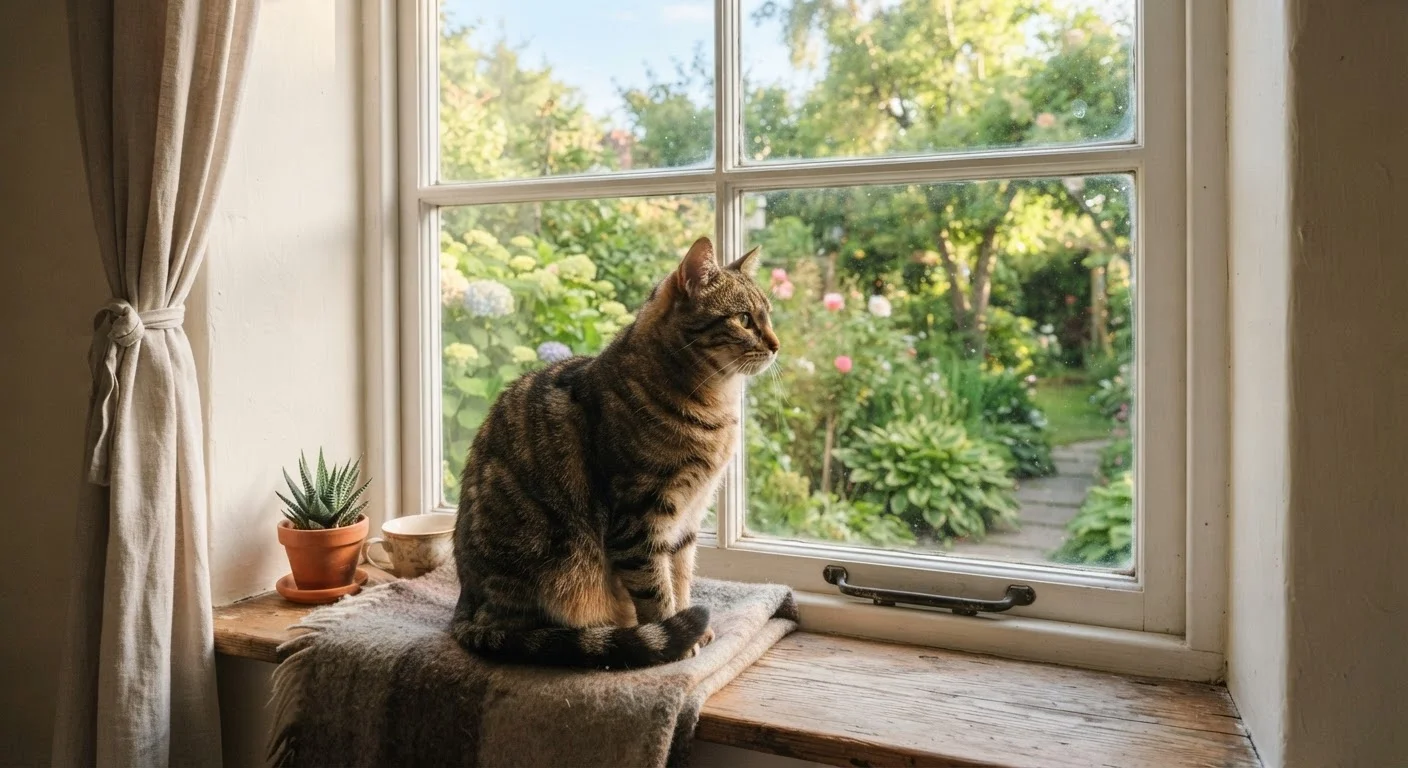
The strongest argument against keeping cats indoors has always been behavioral: boredom, frustration, and weight gain from inactivity. These are legitimate concerns, but they're also solvable ones. An indoor environment that includes climbing structures, puzzle feeders, window perches, interactive play sessions, and social interaction can meet most of a cat's behavioral needs without outdoor exposure.
Veterinary behaviorists increasingly emphasize that the quality of an indoor environment matters more than the square footage. A cat with daily interactive play, vertical space, and mental stimulation is likely to be healthier and calmer than one left inactive indoors. Feeding strategy also plays a role - our overview of dry vs. wet food feeding covers how diet choices intersect with weight and activity levels.
This Is General Information, Not Veterinary Advice
Every cat is different, and the right living arrangement depends on your cat's health history, temperament, and environment. Always consult a licensed veterinarian before making significant changes to your cat's lifestyle, especially for cats with existing health conditions or behavioral concerns.
Middle-Ground Options Worth Considering
For owners who want to offer outdoor experiences without full free-roaming risk, a few approaches have gained traction among veterinary professionals. Enclosed outdoor structures - often called "catios" - allow cats to experience fresh air, sunlight, and sensory variety while remaining physically protected. Leash training is another option, though it suits some cats better than others and typically requires patience to introduce.
Supervised outdoor time in a secure yard is a third option, though it requires the owner to be present and attentive. None of these approaches carries zero risk, but all reduce the major hazards significantly compared to unsupervised roaming. If your cat is spayed or neutered - which reduces roaming drive and territorial aggression - the calculus shifts somewhat. See common myths about spaying and neutering for more context on how that affects behavior and health outcomes.
10-15 yrs
Typical indoor cat lifespan
Veterinary sources generally place indoor-only cat life expectancy in the 12-18 year range, compared to 2-5 years shorter for outdoor cats on average.
~1.3-4B
Birds killed annually by US cats
A widely cited estimate from the Smithsonian Conservation Biology Institute suggests free-roaming cats are among the leading human-linked sources of bird mortality in the US.