How Portions Got So Big
American food portions didn't balloon overnight. Researchers who have studied menu changes over decades document a consistent trend: restaurant entrees, packaged snacks, and fountain drinks have grown substantially since the 1970s and 1980s. A standard fast-food soft drink that was once 7 ounces can now come in cups holding four times that amount. Bagels have roughly doubled in diameter.
This gradual shift has a powerful effect on perception. When supersized portions surround us, they begin to feel like the normal amount to eat - a phenomenon behavioral scientists call portion size normalization. Our brains are wired to use visual cues to judge adequacy, so when a plate arrives heaped with food, finishing it feels like the right thing to do, regardless of actual hunger.
Understanding how we got here is the first step to recalibrating your own sense of what a reasonable amount of food looks like.
Serving Size vs. Portion Size: Know the Difference
These two terms are often used interchangeably, but they mean different things - and mixing them up creates real confusion.
Serving size
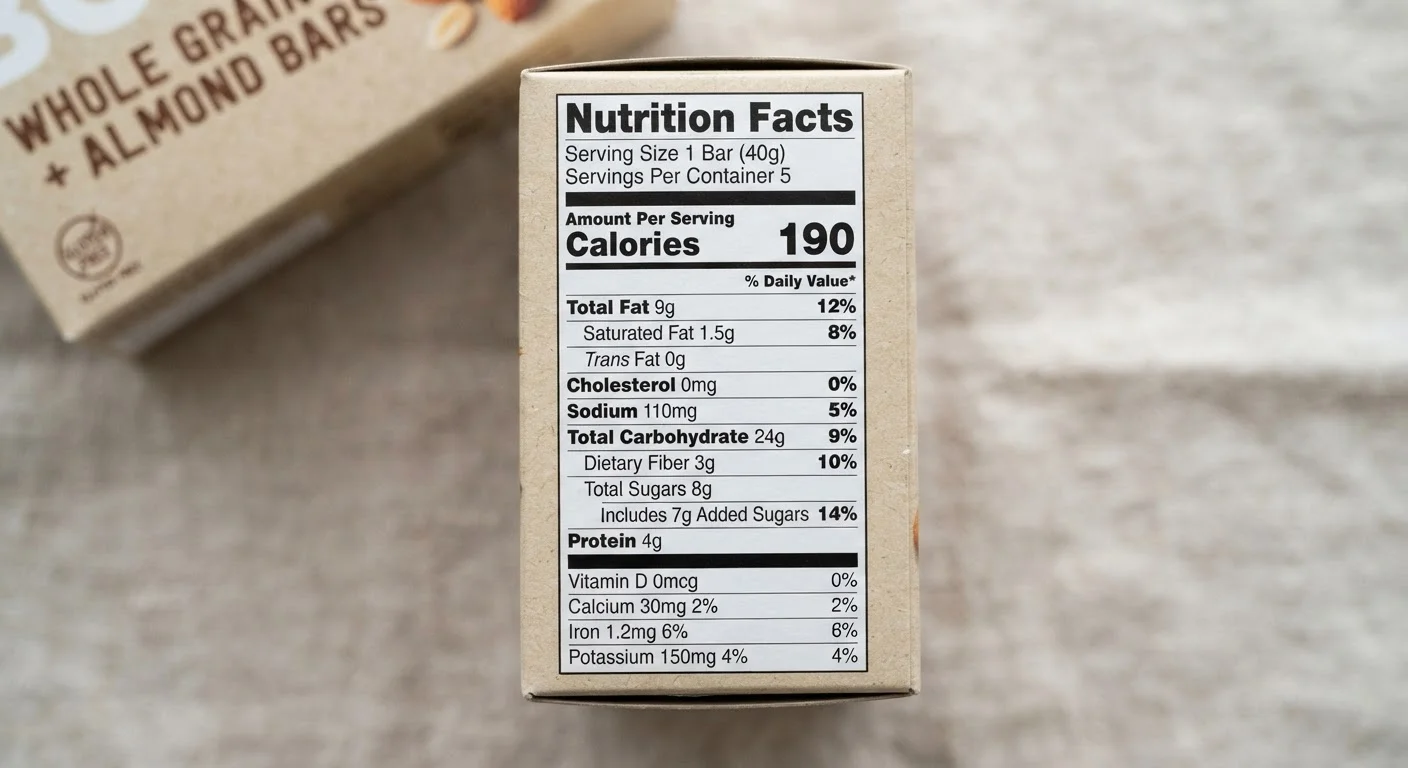
A standardized reference amount established by the FDA and printed on nutrition labels. It tells you how much of a food was measured when calculating the nutrition facts - it is not a dietary recommendation.
Portion size
The actual amount of food you choose to eat in one sitting, which may be larger or smaller than the labeled serving size.
Portion size normalization
A psychological effect in which people begin to perceive oversized food amounts as normal because large portions are consistently present in their environment.
Energy balance
The relationship between the calories you take in through food and the calories your body uses for energy. When intake consistently exceeds use, the body stores the excess.
Hunger and fullness cues
Physical signals your body sends to indicate when it needs food and when it has had enough. These signals can be dulled by eating too quickly or while distracted.
A serving size on a nutrition label is set by the U.S. Food and Drug Administration (FDA) as a standardized reference unit. It reflects the amount people typically consume in one eating occasion, based on national survey data. It is a measuring tool, not a prescription for how much you should eat.
A portion size is what you actually put on your plate. At most sit-down restaurants, one entrée contains multiple servings by the FDA's definition. A large bag of chips may list a serving as 1 ounce (about 15 chips), but most people eat far more in one sitting.
Reading nutrition labels with this distinction in mind is genuinely useful. Our guide The Nutrition Label Decoded walks through exactly how to interpret those numbers accurately.
A Practical Visual Guide to Common Serving Sizes
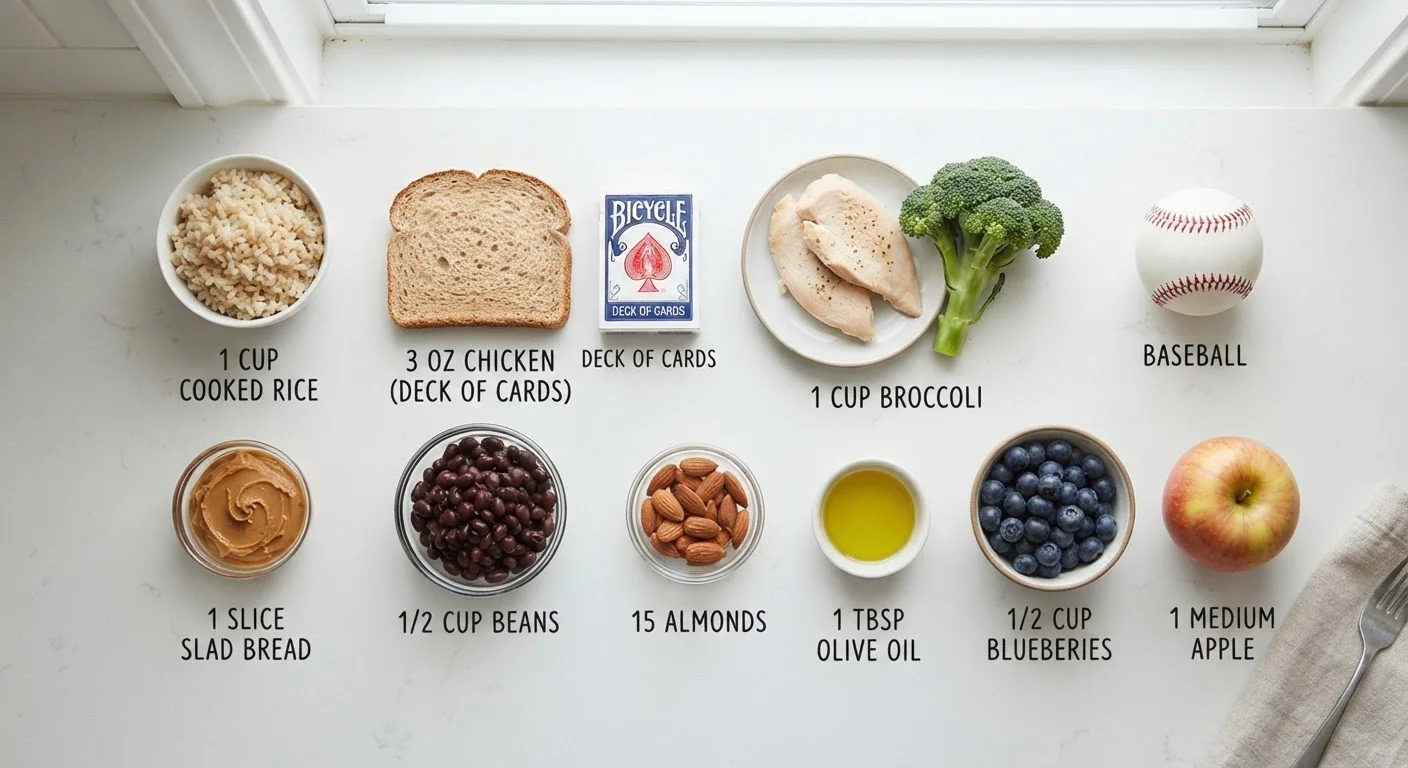
Measuring cups are useful, but they're rarely available at a dinner table or restaurant. A more practical approach is learning to associate standard serving sizes with everyday objects you already know.
Measure Once to Learn, Then Eyeball
If you're new to portion awareness, try measuring one or two common foods - like pasta or cereal - just once to see what a standard serving actually looks like in your own bowls and plates. Most people are surprised. After a few times, your visual estimate becomes much more reliable without any measuring equipment at all.
| Food | Standard Serving | Visual Reference |
|---|---|---|
| Cooked pasta or rice | ½ cup | A tennis ball |
| Cooked meat or fish | 3 oz | A deck of playing cards |
| Salad dressing or oil | 1-2 tbsp | A poker chip |
| Hard cheese | 1.5 oz | Two stacked dice |
| Fresh fruit | 1 medium piece | A baseball |
| Peanut butter | 2 tbsp | A golf ball |
| Nuts | 1 oz (small handful) | A shot glass |
These comparisons aren't laboratory-precise, but they build a reliable intuition that travels with you everywhere - no equipment required.
Why Portion Awareness Matters for Everyday Health
Portion awareness isn't about restriction - it's about having an accurate picture of what you're eating. Consistently underestimating intake makes it harder to notice patterns in your diet, which matters whether your goal is managing energy levels, supporting a health condition, or simply eating in a way that feels sustainable.
Energy balance - the relationship between calories consumed and calories used - is one of the most well-established concepts in nutrition science. When portions regularly exceed what the body needs, the surplus is stored. Over time, this adds up in ways that affect weight and metabolic health. But the reverse is also true: with a clearer sense of amounts, people often find they're satisfied with less food than they thought, particularly when eating more slowly and attentively.
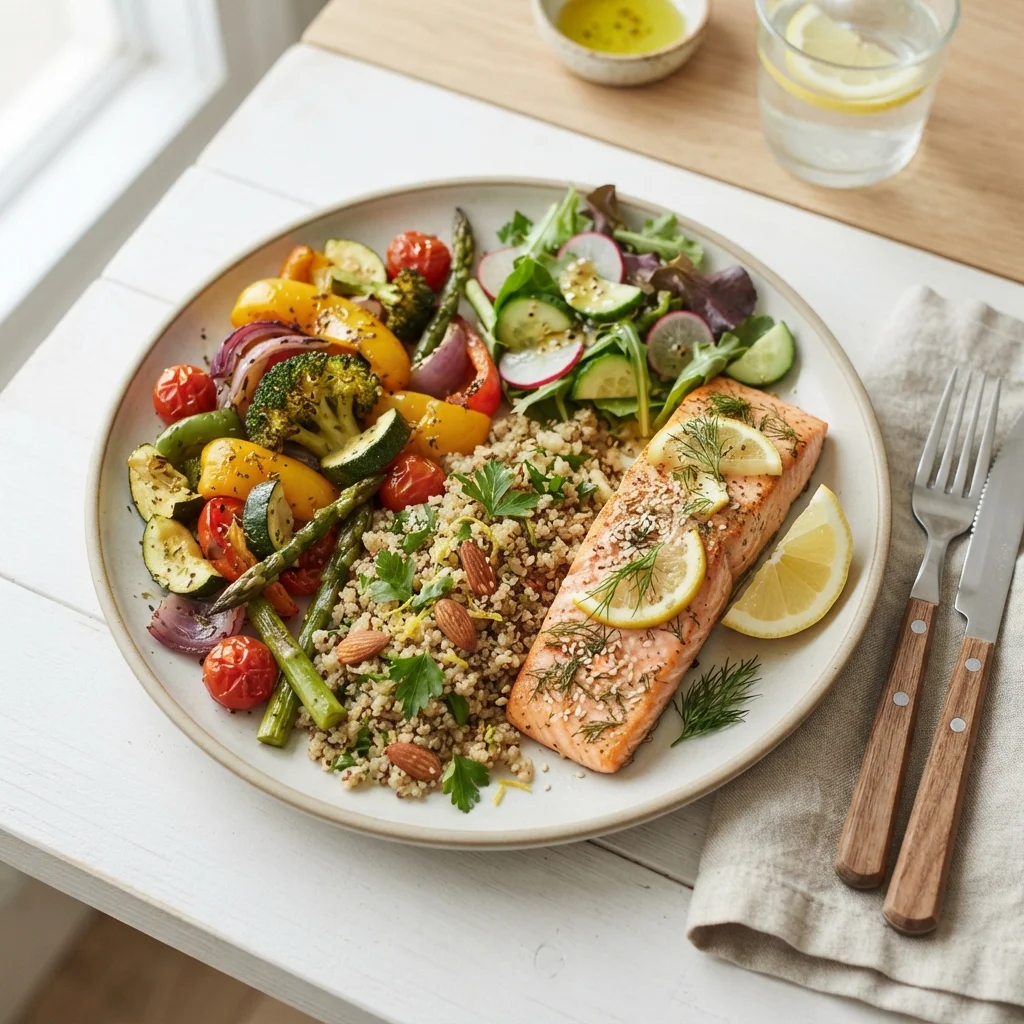
For those managing conditions like type 2 diabetes, high blood pressure, or heart disease, portion awareness can be especially relevant - though any dietary changes for specific conditions should be guided by a registered dietitian or physician. Building a Balanced Plate explores evidence-based approaches to assembling meals that supply the right nutrients without rigid rules.
Simple Habits That Support Better Portion Awareness
Developing portion awareness is a gradual skill, not an overnight fix. These practical habits help most people make meaningful progress without turning every meal into a math exercise.
- Use smaller plates and bowls. Research in behavioral nutrition suggests that plate size influences how much people serve themselves and how full they feel afterward. A standard dinner plate today is significantly larger than plates from decades past.
- Eat without screens. Distracted eating is consistently linked to consuming more food before noticing fullness. Even small reductions in mealtime screen time can shift awareness.
- Pause mid-meal. Hunger and fullness signals take roughly 15-20 minutes to register clearly. Taking a short pause midway through a meal gives your body time to catch up with what you've eaten.
- Measure occasionally. You don't need to measure every meal - but measuring a few common foods periodically helps recalibrate your visual estimates when they drift.
- At restaurants, plan ahead. Consider splitting an entrée, ordering an appetizer as a main, or boxing up half before you start eating. Restaurant portions are not designed around standard serving sizes.
Eating well also intersects with how much you spend. Eating Well on a Budget shows how portion-conscious choices can stretch your grocery dollars further without sacrificing nutrition.
Portion Awareness Is Not a Diet
Learning to recognize standard serving sizes is an educational skill, not a rigid dietary rule. It doesn't require counting every calorie or eliminating foods you enjoy. The goal is simply a clearer, more accurate picture of what you're eating - so your choices are informed rather than accidental.
This article is for general informational and educational purposes only and is not a substitute for professional medical or dietary advice. Consult a qualified healthcare provider or registered dietitian for guidance specific to your health needs.