
The Premium: Your Cost Just to Have Coverage
Think of your premium as a membership fee. You pay it regularly - usually monthly - whether or not you ever file a claim or visit a doctor. Miss a payment, and your coverage can lapse, leaving you unprotected.
Premiums are set by your insurer based on risk factors specific to you and your situation. For health insurance, those factors include age, location, and tobacco use. For auto insurance, your driving record and vehicle type matter. What drives your premium up (and what can bring it down) is worth understanding before you shop for any policy.
One critical point: a lower premium almost always means higher cost-sharing somewhere else - usually through a higher deductible or more coinsurance. You're not getting something for nothing; you're shifting when you pay.
Match Your Plan to Your Usage
If you rarely need medical care or rarely file insurance claims, a higher deductible with a lower premium may save you money overall. If you use coverage frequently, a lower deductible with a higher premium often costs less across the year. Run the numbers on both scenarios before enrolling.
The Deductible: What You Owe Before Insurance Shares the Bill
Your deductible is the dollar amount you must pay out of your own pocket for covered services before your insurer begins sharing costs. If your deductible is $1,500, you pay the first $1,500 of covered expenses each plan year. After that, your insurer starts covering its share.
Deductibles reset at the start of each new policy period - typically each calendar year for health plans, or each claim for some auto and home policies. That reset matters: expenses you paid in December won't carry into January.
Some services - like certain preventive care visits on ACA-compliant health plans - are covered before you meet your deductible. Always check your plan's Summary of Benefits to see which services are exempt.
$1,763
Average individual health deductible (employer plans)
According to the Kaiser Family Foundation's 2023 Employer Health Benefits Survey, the average annual deductible for single coverage in employer-sponsored plans was approximately $1,763.
$703
Average monthly health premium (individual marketplace plan)
KFF analysis of 2024 ACA marketplace data found the average benchmark silver plan premium before subsidies was around $703 per month for a 40-year-old.
43%
Adults who reported difficulty affording deductibles
A KFF Health Care Debt Survey found that roughly 43% of insured adults said they had difficulty affording their deductible at some point.
For a deeper look at how deductibles interact with other cost-sharing features, the full picture of insurance costs is a useful reference.
The Copay: A Flat Fee at the Point of Service
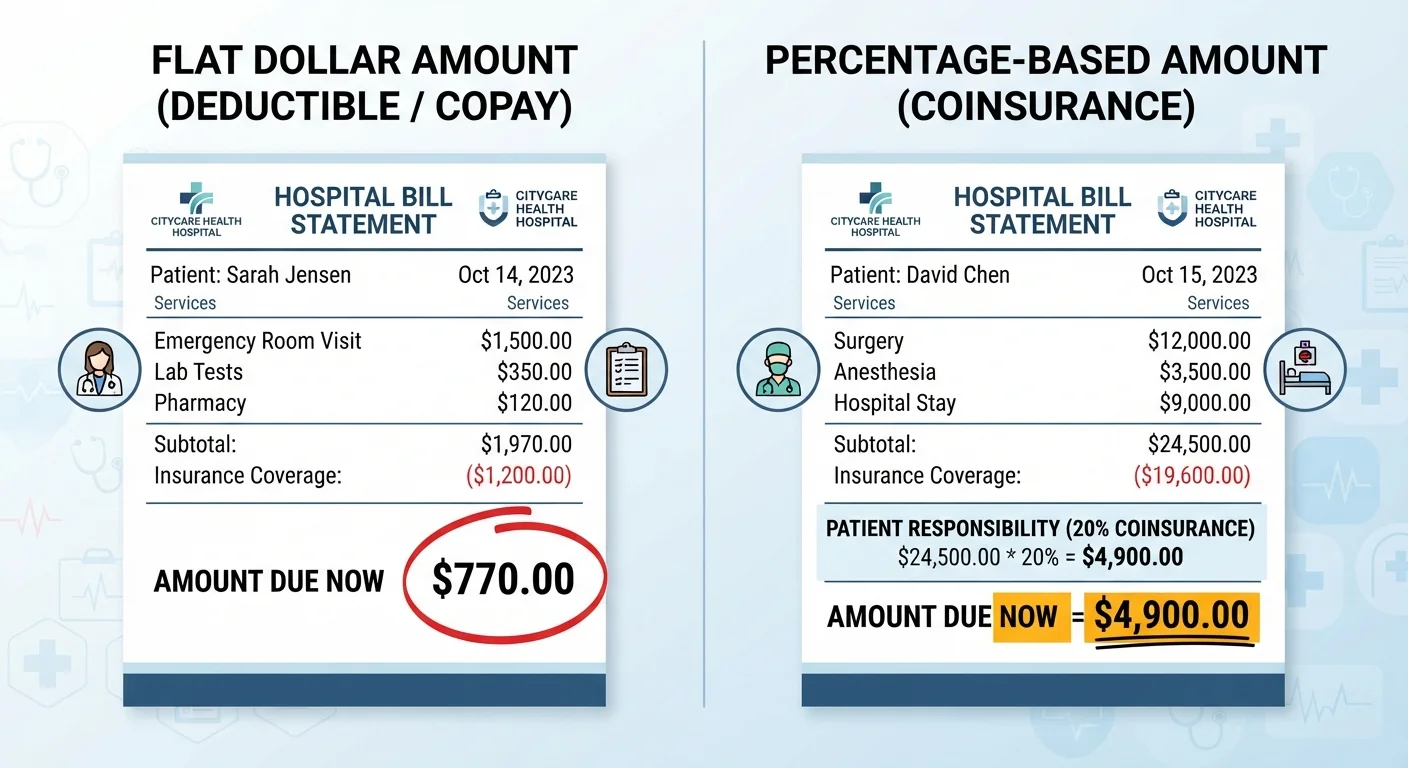
A copay (short for copayment) is a set dollar amount you pay each time you use a specific covered service. Common examples include $25 for a primary care visit, $50 for a specialist, or $10 for a generic prescription. The amount is printed on your insurance card or in your plan documents.
Copays are straightforward: you hand over $30 at the front desk, and that's your share - regardless of whether the actual visit cost $150 or $300. This predictability is one of the reasons many people prefer plans that use copays over plans that rely more heavily on coinsurance.
What copays don't do: they typically don't count toward your deductible, and they only apply to services explicitly listed in your plan. For services not on that list, your deductible and coinsurance rules apply instead. See our guide on copay vs. coinsurance to understand when each applies.
“The single most important thing consumers can do before choosing a health plan is to estimate their likely annual medical costs and compare them against each plan's total potential spending - premium plus deductible plus copays.”
— Karen Pollitz, Senior Fellow, KFF (Kaiser Family Foundation) - health policy researcher and consumer insurance expert
How All Three Work Together in a Real Situation
These three cost terms don't operate in isolation - they stack. Here's a simplified example using a health insurance scenario:
- You pay your monthly premium of $350 to keep your plan active.
- In March, you see your primary care doctor. You owe a copay of $30 at the visit - no deductible applies here because your plan covers office visits with a copay.
- Later, you need a diagnostic test. The lab bill is $800. Because your plan requires you to meet a $1,000 deductible for this type of service, you pay the full $800. You now have $200 left before your deductible is met.
- A follow-up test costs $500. You pay the remaining $200 of your deductible, then your coinsurance kicks in for the other $300.
This layered structure is why reading your plan's cost summary page is so important - each plan arranges these pieces differently. The cost summary page guide walks through how to read that document line by line.
This article is for general informational purposes only and does not constitute personalized insurance, financial, or legal advice. Coverage terms, costs, and rules vary by insurer, plan, and state. Always review your actual policy documents and consult a licensed insurance professional for guidance specific to your situation.