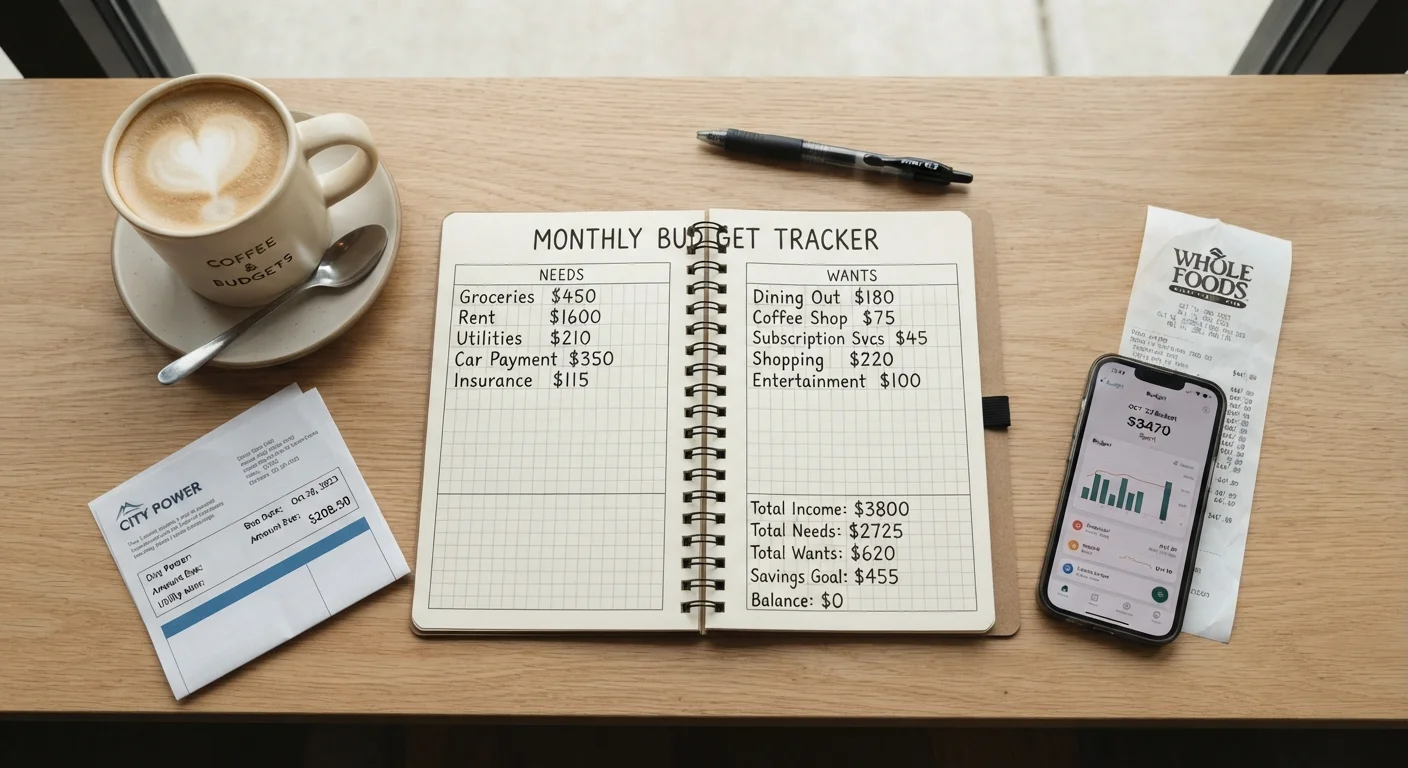
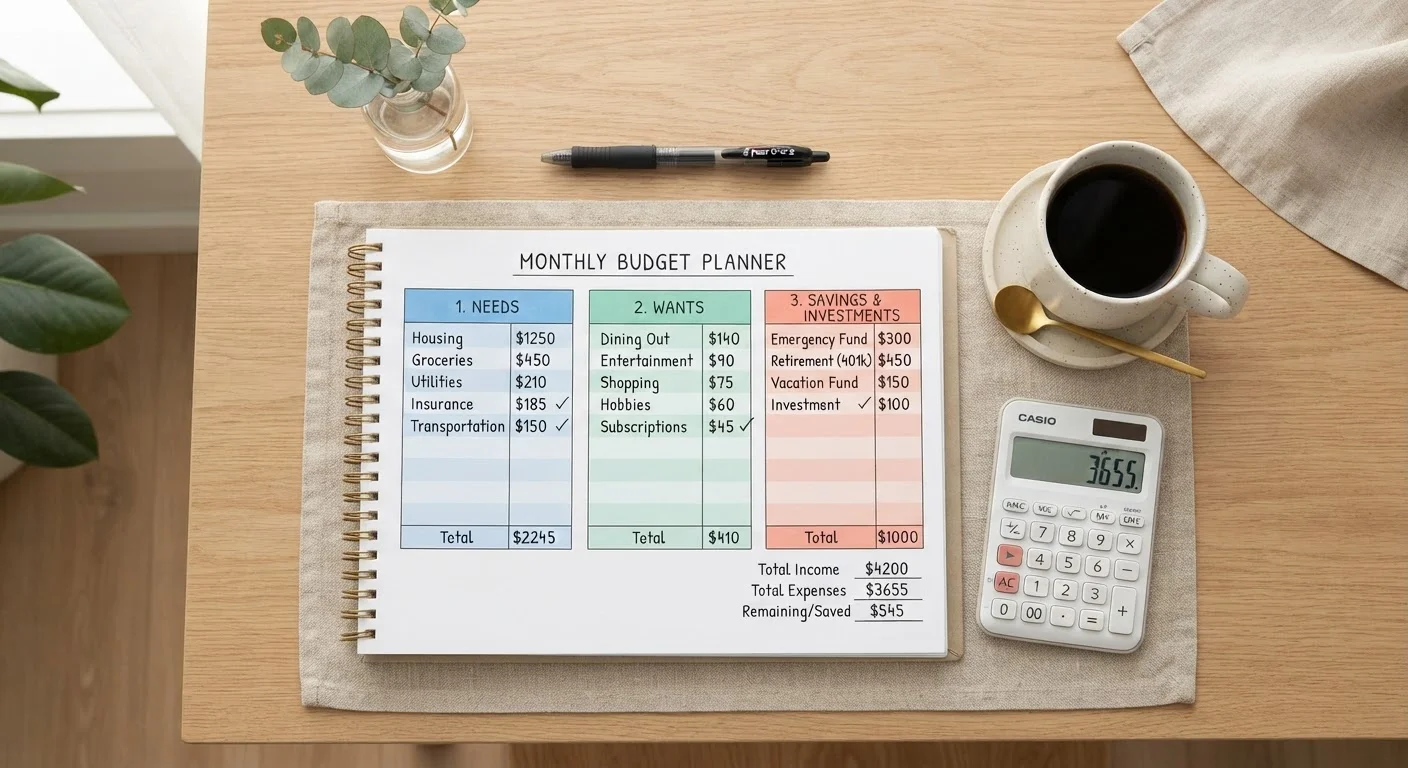
How the Three Categories Work
The 50/30/20 rule starts with your after-tax income - what actually lands in your bank account each month. From there, you split it into three buckets.
- 50% - Needs: Expenses you must pay to live and work. Rent or mortgage, utilities, groceries, health insurance, car payments for essential transportation, and minimum payments on any debt.
- 30% - Wants: Spending that improves your life but isn't strictly required. Dining out, subscriptions, vacations, clothing beyond basics, and entertainment all go here.
- 20% - Savings and debt repayment: Money set aside for the future. This includes emergency fund contributions, retirement savings, and any extra payments above the minimum on loans or credit cards.
The dividing line between needs and wants is where most people get stuck. A car may be a need; a luxury upgrade is a want. Basic groceries are a need; a weekly restaurant habit is a want. For a deeper look, see drawing the line in your own spending.
Start with One Month of Real Data
Before adjusting your spending, spend a month tracking what you actually do - not what you plan to do. Most people underestimate their wants spending by 20-30%. Real numbers make the 50/30/20 framework far easier to apply accurately. Many free budgeting apps can categorize transactions automatically from your bank feed.
Putting It Into Practice
Applying the rule takes three steps: calculate your monthly after-tax income, multiply by each percentage, and compare the results against your actual spending.
- Find your baseline. Add up your take-home pay for a typical month. If income varies, use a conservative average from the past three to six months.
- Set your targets. Multiply your monthly take-home by 0.50, 0.30, and 0.20 to get dollar amounts for each category.
- Audit your current spending. Pull one to two months of bank and credit card statements. Assign each expense to a category and total them up.
If your needs exceed 50%, look for ways to reduce fixed costs over time - refinancing, downsizing, or finding lower-cost alternatives. If your wants are eating into your savings slice, that's where the adjustment starts.
50%
Recommended ceiling for monthly essential expenses
The 50/30/20 framework allocates no more than half of after-tax income to needs like housing, food, and utilities.
~33%
Average share of income spent on housing alone
According to U.S. Bureau of Labor Statistics Consumer Expenditure Survey data, housing consistently represents the largest single spending category for American households.
20%
Savings and debt repayment target
Financial educators broadly recommend saving at least 20% of take-home pay, with emergency fund contributions prioritized before other goals.
Once you have a realistic picture, set up a monthly budget reset routine to check in on each category regularly.
When the Rule Fits - and When It Doesn't
The 50/30/20 rule works well for people with stable, predictable income who are new to budgeting and want a framework that doesn't require tracking every cup of coffee. Its simplicity is its strength.
It fits less neatly when:
- Housing costs are high. In many U.S. cities, rent alone can consume 40-50% of take-home pay, leaving no room for other needs.
- Income is irregular. Freelancers and gig workers may need a more dynamic approach to match variable earnings.
- Debt is heavy. Aggressive debt payoff often requires redirecting the wants percentage temporarily, breaking the standard split.
Adjusting the Split Is Not Failure
The 50/30/20 percentages are a widely used starting point, not a universal prescription. Many financial educators acknowledge that the rule was designed with a median income in mind. If your numbers don't fit neatly, adjusting the ratios to reflect your actual circumstances is both acceptable and sensible - the important thing is having a structure at all.
For a detailed look at how this framework stacks up against other approaches, the comparison on zero-based budgeting vs. the 50/30/20 rule walks through the trade-offs side by side. Whatever structure you choose, the saving strategies hub offers practical tactics that complement any budgeting framework.
This article is for general informational and educational purposes only and does not constitute personalized financial advice. Consult a qualified financial professional for guidance specific to your situation.