
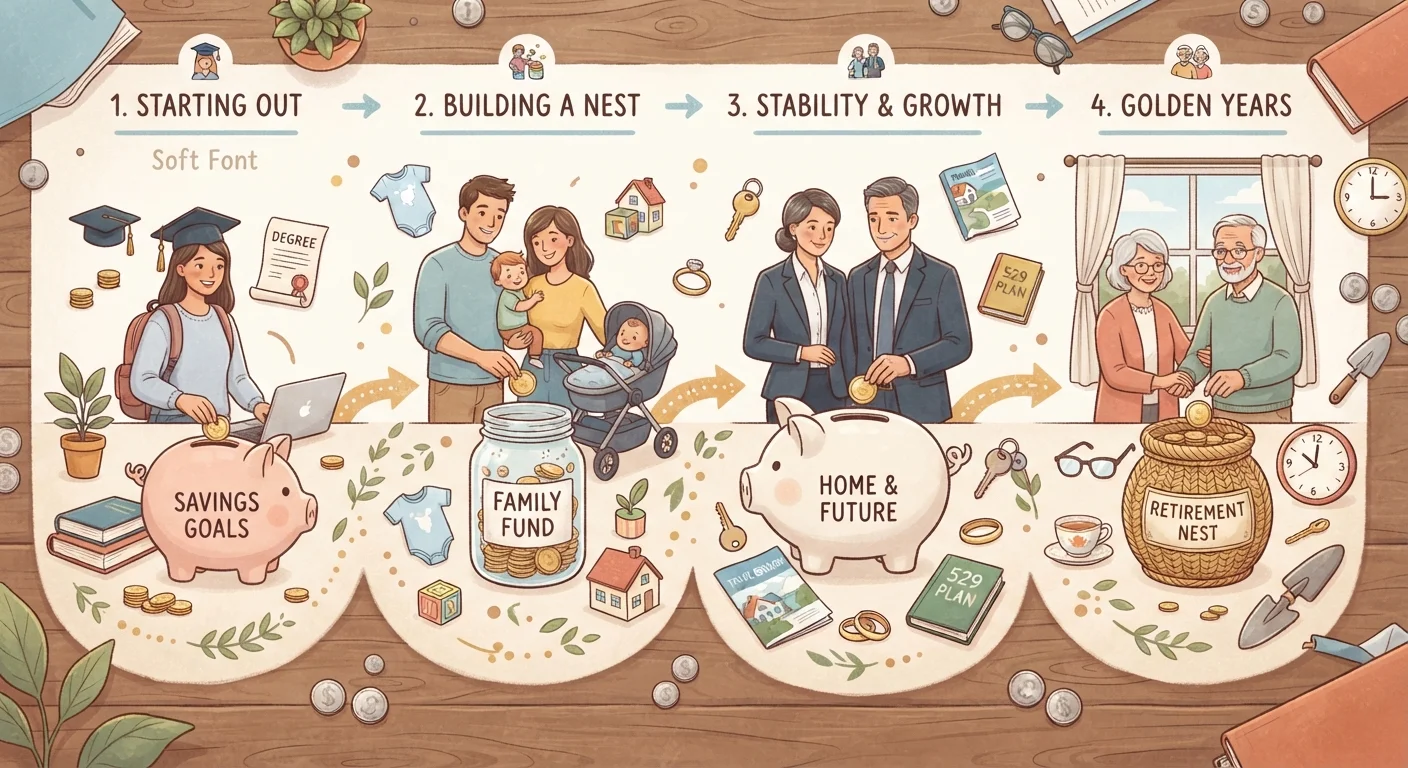
Why Life Stage Matters More Than Income Level
When people think about saving, income is the first variable that comes to mind. But research from the Federal Reserve's Survey of Consumer Finances consistently shows that what you're saving for - and the time horizon attached to it - shapes your strategy as much as how much you earn. A 28-year-old and a 55-year-old with identical incomes should be making very different decisions about risk tolerance, account types, and savings targets.
Life stage reflects your current obligations, your remaining earning years, and the financial tools legally available to you. Understanding where you are in that arc helps you stop comparing yourself to the wrong benchmarks and start making decisions that fit your actual situation.
This guide walks through three broad phases - early adulthood, mid-life, and pre-retirement - and then identifies the saving principles that hold across all of them. For a grounding look at how saving habits hold up when money is genuinely tight, see our guide to saving on a tight budget.
36%
Americans with no retirement savings
According to Federal Reserve survey data, a significant share of non-retired adults report having no retirement savings or pension at all.
3-6 months
Recommended emergency fund coverage
Most financial education organizations recommend covering three to six months of essential living expenses in accessible savings before pursuing other goals.
~50%
Workers who have access to employer retirement plans
Bureau of Labor Statistics data indicates that roughly half of private-sector workers have access to a workplace retirement plan, with participation rates varying by income level.
Early Adulthood (20s): Building the Foundation
Your 20s are characterized by lower earnings, high flexibility, and - crucially - time. Time is the most valuable asset in long-term saving because of how compounding works: returns earned on savings generate their own returns over subsequent years. Even modest contributions started early have decades to grow.
Key priorities at this stage:
- Emergency fund first. Aim to accumulate three to six months of essential expenses in a liquid, accessible account before directing money toward longer-term goals. This buffer prevents one unexpected cost from derailing everything else.
- Employer retirement plans. If your employer offers a workplace retirement account with any matching contribution, prioritize contributing at least enough to capture that match. Passing it up is effectively leaving part of your compensation on the table.
- Automate contributions. Setting transfers to happen automatically right after payday removes the temptation to spend first. See how the mechanics actually work in our guide to automating your savings.
Debt management also belongs in this phase. High-interest consumer debt erodes the value of any saving you do simultaneously, so the math often favors paying it down aggressively while still maintaining a minimum contribution to tax-advantaged accounts.
Treat your savings contribution like a fixed bill - schedule it the day after your paycheck clears so it never competes with discretionary spending.
Behavioral finance research consistently shows that pre-committing money before it reaches a spending account is one of the most reliable ways to maintain saving habits, especially when income is variable.
Every time you get a raise, direct at least half the increase toward savings before it's factored into your regular budget.
Lifestyle inflation is one of the primary reasons mid-career earners don't accumulate proportionally more than early-career ones. Capturing increases before spending patterns adjust is a structural solution.
Mid-Life (30s-40s): Competing Priorities, Bigger Stakes
The middle decades tend to bring higher earnings - but also the most demanding financial obligations. Mortgage payments, childcare, education costs, aging parent support, and career transitions can all arrive simultaneously. Saving during this phase requires deliberate prioritization rather than hoping there's something left over at month's end.
What shifts in this phase:
- Goal layering. You're likely saving for retirement, a child's education, a home, and near-term large purchases all at once. Separate accounts for each goal - even small ones - make progress visible and reduce the urge to raid one fund for another. For planned large expenses, our guide to saving for a big purchase provides a practical framework.
- Risk recalibration. With retirement still 20-plus years away in your 30s, you generally have capacity to hold growth-oriented assets - but as you enter your 40s, most financial professionals suggest beginning a gradual shift toward balance. This is highly individual and warrants professional guidance.
- Income increases should flow partly to savings. Lifestyle inflation - spending more as you earn more - is one of the most common ways mid-life savers plateau. Committing a portion of each raise or bonus to savings before it reaches your checking account is a simple structural defense.
Watch Out for Lifestyle Inflation
One of the most common mid-life saving pitfalls is spending more simply because you earn more - a pattern known as lifestyle inflation. Each salary increase or bonus that gets absorbed into routine expenses without any corresponding increase in savings effectively resets your progress. Building the habit of saving a fixed percentage of income, rather than a fixed dollar amount, helps your contributions grow alongside your earnings.
Understanding spending triggers that chip away at savings is especially useful in this life stage, when social and lifestyle pressures often peak.
Pre-Retirement (50s-Early 60s): The Catch-Up Phase
The decade or two before retirement brings a meaningful shift in both urgency and available tools. Income is often near its peak, children may be financially independent, and the U.S. tax code provides specific incentives for this phase.
Tools and strategies worth knowing:
- Catch-up contributions. The IRS allows workers aged 50 and older to contribute additional amounts beyond the standard annual limits to qualified retirement accounts (such as 401(k)s and IRAs). The exact figures are updated periodically, so check the current IRS guidance or consult a financial adviser for current limits.
- Social Security timing. The age at which you begin claiming Social Security benefits has a permanent effect on your monthly amount. Delaying past the minimum eligible age generally increases your benefit, but the right decision depends on health, other income sources, and household circumstances. A licensed adviser can model scenarios for your situation.
- Healthcare cost planning. Healthcare is one of the largest variable costs in retirement. Pre-retirees should understand how Medicare eligibility works and what bridge coverage options exist between employer coverage and Medicare age - this affects how much liquid savings you may need.
Starting Late Is Still Better Than Not Starting
It's common for people in their 50s to feel they've missed the window for meaningful retirement saving. That perception often leads to inaction, which only widens the gap further. Even modest contributions in the final working decade - especially using catch-up limits - can meaningfully improve retirement outcomes. Seek personalized guidance from a licensed financial adviser to understand what's realistically achievable for your situation.
If you feel behind, focus on what's actionable now rather than fixating on the past. Even late contributions to tax-advantaged accounts can reduce your taxable income and grow meaningfully before you stop working. For a broader look at saving assumptions worth questioning, see our article on common saving beliefs that financial educators push back on.
What Never Changes: The Constants of Smart Saving
Across all life stages, several principles remain consistently supported by financial education research and practitioner guidance:
- Automation beats willpower.
- Automatic transfers remove friction and decision fatigue. Most people save more when the system does the work.
- Consistency outperforms timing.
- Whether you're 25 or 55, contributing regularly in smaller amounts tends to outperform sporadic large contributions over time. Our article on lump-sum vs. consistent contributions walks through the real trade-offs.
- High-yield accounts earn more on the same balance.
- A standard savings account and a high-yield savings account hold the same dollar amount differently - the interest gap compounds over time. Understanding that difference is worth the 20 minutes it takes. See our comparison of high-yield vs. traditional savings accounts for a clear side-by-side breakdown.
- Review and adjust.
- Life changes. A savings strategy built for one phase may be misaligned in the next. A brief annual review of your goals, contributions, and account structure keeps your plan relevant.
Annual Check-In: A Simple Three-Question Review
Once a year, ask yourself: Has my income changed significantly? Have my major financial goals shifted? Are my automatic contributions still set at the right level? A 20-minute review once a year is often enough to catch misalignments before they cost you. Mark it on the calendar like any other important appointment.
Putting It All Together
No saving strategy fits every household, and life rarely moves in a straight line. Job changes, family transitions, health events, and economic shifts all create moments where the plan needs revisiting. The goal isn't perfection - it's maintaining the habit of prioritizing saving, even when the amount or vehicle changes.
Use your life stage as a lens, not a rigid rulebook. If you're in your 40s without a strong emergency fund, building that is still the right first step regardless of what the typical mid-life playbook suggests. If you're in your 20s with genuine capacity to save aggressively, the fact that most peers aren't doesn't mean you shouldn't.
For a grounding reference on how financial decisions fit within a broader household framework, explore our budgeting basics hub and our smarter spending resources.
This article covers general financial education concepts and is not personalized financial advice. Your individual circumstances - income, debt, dependents, tax situation, health, and goals - all affect what strategies make sense for you. Consider consulting a licensed financial adviser or planner before making significant changes to your saving or investment approach.
This article is for informational purposes only and does not constitute personalized financial, tax, investment, or legal advice. Consult a qualified financial professional before making decisions based on your individual situation.
“The best time to start saving was yesterday. The second-best time is today. The worst thing you can do is wait for a perfect moment that never comes.”
— General Financial Education Principle, Widely cited in consumer financial literacy programs across the United States