Why Pattern Mixing Feels Scary (And Why It Shouldn't)
The idea of wearing two prints at once stops a lot of people cold. It sounds like a move reserved for fashion editors or people who are just naturally "stylish." But pattern mixing isn't a personality trait - it's a skill, and it's governed by a surprisingly small set of principles that anyone can apply.
The same goes for proportion. Wearing a flowy blouse with wide-leg trousers, or an oversized jacket with slim pants, can look effortlessly intentional or accidentally chaotic - and the difference usually comes down to one or two deliberate choices, not an entire wardrobe overhaul.
If your outfits often feel "almost right," proportion and pattern awareness are likely the missing pieces. For a deeper look at what else might be holding your wardrobe back, see why your outfits never seem to come together.
The Core Practices for Mixing Patterns Confidently
These principles work across body types and budget levels. Start with one or two, and build from there.
Vary pattern scale when mixing two prints
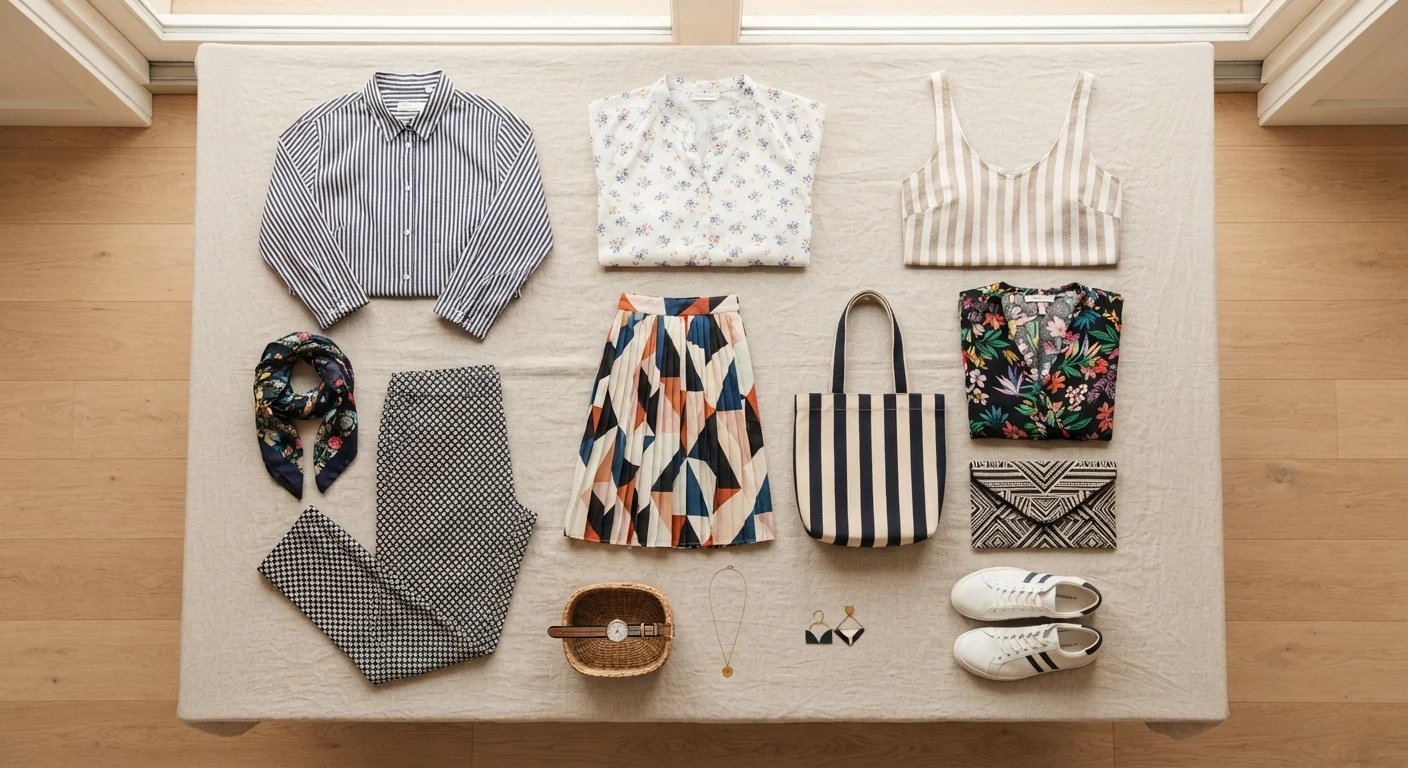
When two patterns are the same size - say, two medium florals - they visually compete and create noise. Pairing a large-scale print with a small-scale one gives each room to breathe and lets the eye move naturally between them.
Find a shared color to anchor mixed patterns
Two prints that share even one color feel cohesive because the eye perceives a through-line. Without a connecting color, the combination reads as accidental. This is the single easiest check before committing to a mixed-print outfit.
Use a solid as a visual rest between two patterns
If two prints feel like too much, a solid-colored layer between them - a belt, an outerwear piece, or a simple bottom - gives the eye a place to land. It reduces visual complexity without abandoning the pattern-mixing concept.
Balance volume deliberately - one fitted, one relaxed
Proportion imbalance is one of the most common reasons an outfit feels "off." When the volume of your top and bottom are similar, silhouettes can blur together. Intentional contrast creates definition and visual interest.
Tuck, half-tuck, or crop to define your waist optionally
Showing or suggesting a waistline - even subtly - introduces proportion to an otherwise uniform silhouette. It's not about body type; it's about creating visual sections that make an outfit feel intentional.
Proportion: The Rule That Changes Everything
Proportion is about visual weight - how much of your silhouette is dominated by any one element. When every piece in an outfit competes for attention with equal volume, the result reads as heavy or undefined. When volume is intentionally placed, the whole look feels balanced.
The Half-Tuck Is Your Best Friend
A half-tuck - tucking just the front of a shirt into your waistband - is one of the most effective low-effort proportion tricks. It breaks up a uniform silhouette, suggests a waistline without cinching, and makes a casual outfit look thoughtfully assembled. It works on most body types and requires zero additional pieces.
The most dependable proportion formula: one fitted piece, one relaxed piece. This doesn't mean tight and baggy - it means structured and fluid, or streamlined and draped. A fitted turtleneck with wide trousers. A flowy midi skirt with a tucked-in slim tee. These pairings create contrast that reads as intentional rather than accidental.
For more on how silhouette choices interact with body shape, dressing for your body shape offers a flexible, non-prescriptive framework worth exploring.
Quick Wins You Can Try Today
You don't need to shop for any of this. Start with what's already hanging in your closet.
Building a wardrobe where these principles work seamlessly starts with having the right foundational pieces. If you're starting fresh or refining what you own, building your first versatile wardrobe is a practical place to begin. And if you want to understand how neutral colors make both pattern mixing and proportion balancing easier, neutral colors in fashion breaks down exactly how to use them as your anchor.