Why These Options Fly Under the Radar
Most long-distance commuters default to one calculation: car payment, gas, and insurance versus the inconvenience of anything else. That math often misses a category of publicly subsidized transportation options that can dramatically reduce both cost and daily stress - options that exist in most metropolitan regions but that many commuters don't know are available to them.
Park-and-ride facilities, vanpool programs, and commuter rail lines are typically administered by regional transit authorities or state transportation departments. They're designed specifically for the long-haul commuter - someone traveling 20 to 60 miles each way - who can't walk to a bus stop but who also doesn't need to arrive at work behind the wheel. If you're spending more than an hour a day driving and wondering whether there's a smarter way, these tools deserve a serious look. For a broader map of all mobility options available today, see our overview of modern mobility options.
Park-and-Ride Facilities
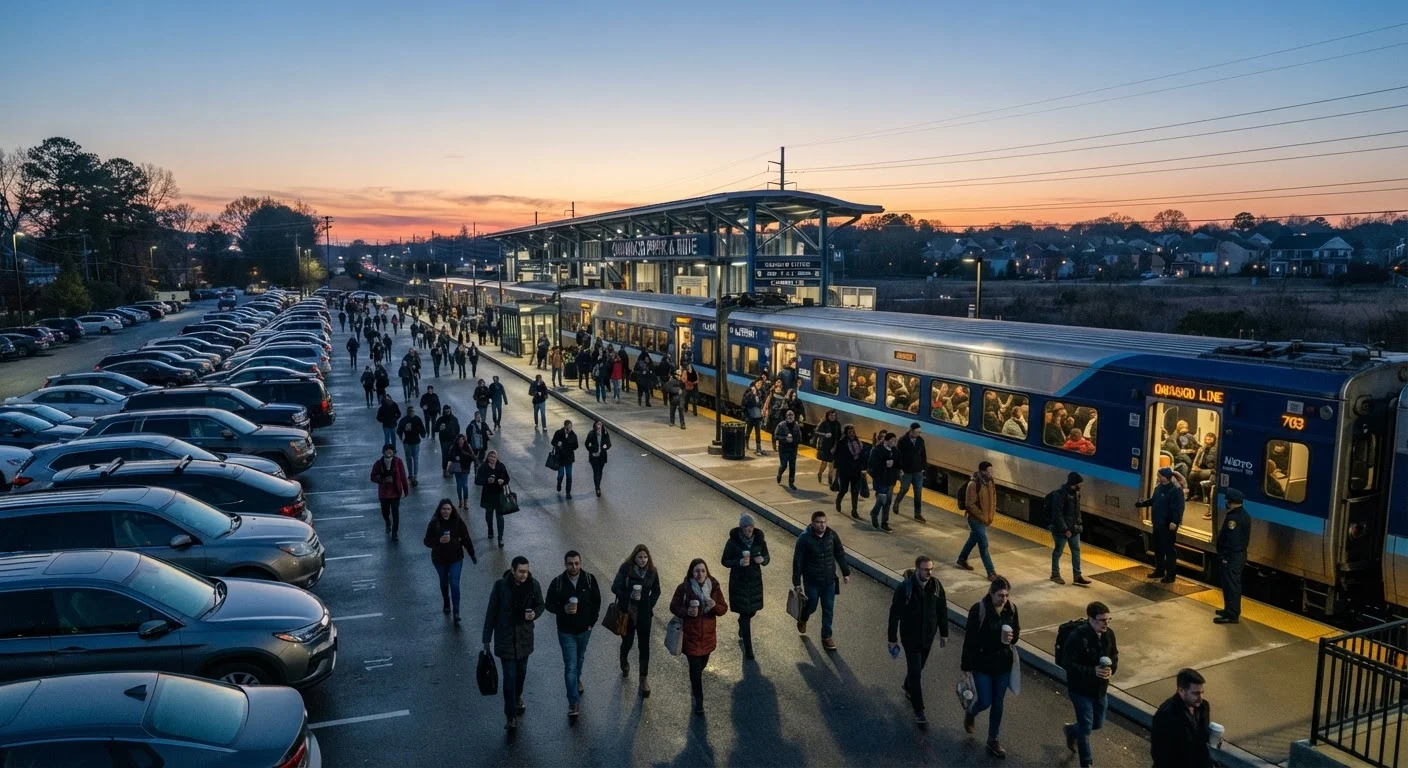
A park-and-ride lot lets you drive from home to a designated parking facility - typically near a highway interchange or transit hub - and continue your commute by bus, rail, or carpool from there. Parking at these facilities is usually free or low-cost, funded through regional transportation agencies. The goal is to reduce single-occupancy vehicle traffic on congested corridors while giving drivers a realistic on-ramp to transit.
Who benefits most: commuters who live in areas without walkable transit access but who work in or near a dense urban core where parking is expensive or scarce. If downtown parking runs $20-$30 per day, a free park-and-ride lot plus a $6 round-trip bus ticket can represent meaningful monthly savings - often $300 or more compared to driving all the way in.
To find facilities near you, search your regional transit authority's website or your state's department of transportation. Most maintain searchable maps with lot capacity, hours, and any amenities like sheltered waiting areas or EV charging.
Free or low-cost park-and-ride parking can save commuters $300 or more per month compared to downtown parking.
Vanpool Programs
Vanpools are shared commuting arrangements where a small group - typically 7 to 15 people - travels together in a van along a consistent route. What surprises many commuters is that vanpool programs are frequently organized and subsidized by regional transit agencies, not just private employers. Agencies like LA Metro, WMATA in the DC region, and many state DOTs operate or financially support vanpool programs through subsidized vehicle leasing, insurance, and fuel assistance.
The driver typically rides free or at a reduced cost in exchange for driving duties. Other riders share the remaining cost, which can be substantially lower than solo driving when fuel, insurance, and depreciation are factored in. Participants can also apply employer pre-tax commuter benefits - see how commuter benefit programs work - to offset their share of vanpool costs.
Vanpools work best on fixed, predictable corridors with consistent demand. They require enough schedule flexibility to accommodate a shared departure time, which isn't ideal for everyone but suits a large share of 9-to-5 office workers.
Vanpool riders can use pre-tax commuter benefits to offset their share of costs, reducing the effective price further.
Commuter Rail Lines
Commuter rail - distinct from intercity Amtrak service or urban subways - is designed for daily round trips between suburbs and city centers. These lines typically operate during peak morning and evening hours, with longer distances covered at higher speeds than local buses. Examples include Metra in Chicago, MARC in Maryland, Caltrain in the Bay Area, and similar systems across the country.
Monthly passes on commuter rail are usually priced to reward regular use, and the cost per mile is often significantly lower than driving when you account for fuel, vehicle depreciation, tolls, and parking. The added benefit - time - is frequently undervalued: a 45-minute train ride where you can read, work, or simply decompress is qualitatively different from 45 minutes of highway driving.
Commuter rail is most practical when your origin and destination are both reasonably close to stations. It pairs well with park-and-ride at the suburban end and a short bike ride, bus connection, or local transit leg at the urban end.
Commuter rail monthly passes often cost significantly less per mile than driving once depreciation, tolls, and parking are included.
Employer-Sponsored Shuttle Services
A less widely discussed but growing option: some large employers - particularly in tech, healthcare, and higher education - operate dedicated shuttle services for employees commuting from specific origin points. These shuttles are often free to employees and can cover suburban corridors not served by public transit.
If you're not sure whether your employer offers this, check with HR or your facilities department. The service may not be prominently advertised. For workers relocating to a new city, asking about shuttle availability before accepting an offer is a reasonable part of evaluating total compensation - much like evaluating the transit network itself, as outlined in our guide to assessing a city's transit options before relocating.
Employer shuttle programs often go unadvertised - asking HR directly is the most reliable way to find out if one exists.
Transportation Demand Management (TDM) Programs
Many regional transportation agencies run broader programs called Transportation Demand Management, or TDM, initiatives. These programs act as a coordination hub - matching commuters to vanpools, providing trip-planning assistance, offering guaranteed ride home programs (a safety net that provides a free taxi or rideshare if you're stranded after using transit), and sometimes providing direct financial incentives for leaving the car at home.
TDM programs are publicly funded and free to use. They exist in most major metro areas and are often administered under names like RideShare, CommuteInfo, or similar regional branding. A guaranteed ride home program in particular addresses one of the biggest hesitations people have about giving up solo driving: the fear of being stranded if an emergency arises. These programs dramatically reduce that risk. For commuters building a mixed mobility strategy, TDM resources are a logical starting point - complementing the approaches covered in structuring a car-free or car-light transportation budget.
Guaranteed ride home programs remove one of the biggest barriers to giving up solo commuting - fear of being stranded.
Making the Right Combination Work for You
The most effective long-distance commuters often stack these tools rather than rely on just one. A park-and-ride lot paired with a commuter rail pass, for example, eliminates both the downtown parking cost and the highway driving stress. A vanpool combined with pre-tax employer commuter benefits can cut out-of-pocket transportation expenses by hundreds of dollars a month.
Start With Your Regional Transit Authority
Most commuters underestimate what their regional transit agency offers. Before assuming none of these options apply to you, spend 10 minutes on your regional transit authority's website or call their commuter services line. Many agencies have staff specifically tasked with helping commuters identify the right combination of services for their corridor. It costs nothing to ask.
Before committing to any arrangement, check what your employer offers. Pre-tax commuter benefit programs - sometimes called commuter FSAs or transit benefit programs - can be applied to vanpool costs and transit passes up to IRS-set monthly limits. Our article on how employer commuter benefits work walks through exactly what qualifies. If you're also thinking about how transit can fit alongside - rather than replace - your car, using transit as a supplemental option is worth a read.
This article provides general transportation information for educational purposes. Costs, program availability, and eligibility vary significantly by region and employer. Contact your regional transit authority or HR department for details specific to your situation.