
Why Screen Time Debates Are So Emotionally Charged
Every new technology introduced into family life has sparked moral concern - television, video games, and now smartphones and tablets. That pattern matters, because it reminds us that anxiety about screens isn't always rooted in proportionate evidence. It's worth asking: what does the research actually support, and where does legitimate concern end and cultural panic begin?
Screen time sits at the intersection of parenting identity, child development science, and public health messaging - which makes it unusually hard to discuss clearly. Parents feel judged regardless of their choices, and headlines rarely distinguish between a toddler watching educational video with a caregiver and a teenager doom-scrolling alone at midnight. Those are meaningfully different situations, and the science treats them that way too.
For a fuller picture of how household routines affect family health, see our overview of proactive versus reactive family health approaches.
Common Myths - and What the Evidence Actually Shows
Below are some of the most persistent misconceptions about screen time and family health, each examined against current research and clinical guidance. This content is general health information, not medical advice - always speak with a qualified healthcare professional about your family's specific needs.
Myth
All screen time is harmful to children's development, regardless of how it's used.
Fact
Research distinguishes clearly between types of screen use; interactive and educational screen time carries a different developmental profile than passive, unstructured consumption.
Major pediatric and public health bodies, including the American Academy of Pediatrics, have moved away from blanket time limits for children older than 2, emphasizing quality and context over raw minutes. Controlled studies find that co-viewed educational content can support language development in preschoolers. The harm model tied to screens is more nuanced than the phrase "screen time is bad" suggests.
Myth
The two-hour-per-day rule is backed by solid, definitive science for school-age kids.
Fact
The two-hour guideline originated from older sedentary-behavior research and has been substantially revised; current guidance is more flexible and age-differentiated.
Early screen time limits were largely derived from TV-viewing studies conducted before smartphones existed. As the research base has grown, recommendations have been updated to focus less on a fixed ceiling and more on whether screen use is displacing sleep, physical activity, and social interaction. Families following a rigid two-hour rule aren't necessarily wrong, but the number itself doesn't have the empirical precision it's often assumed to carry.
Myth
Social media use directly causes depression and anxiety in teenagers.
Fact
Studies show associations between heavy social media use and poorer mental health outcomes in some adolescents, but causality is not firmly established and the effect sizes are often modest.
Large longitudinal analyses, including work by researchers at institutions like the Oxford Internet Institute, have found that the correlation between social media use and adolescent wellbeing is real but smaller than media coverage typically implies. Factors like pre-existing vulnerability, the nature of use (active versus passive), and offline social support significantly moderate outcomes. The relationship is bidirectional in many studies: adolescents who are already struggling may use social media more, not only the reverse.
Myth
Screen time before age two causes lasting brain damage.
Fact
Pediatric guidelines recommend very limited screen use under age two - except video calls - primarily because that period benefits from rich in-person interaction, not because screens cause permanent neurological harm.
The concern for very young children is about opportunity cost: a toddler watching a screen is not engaged in the responsive, back-and-forth human interaction that drives early language and social development. The evidence for irreversible damage from incidental exposure is not established. The guideline is a protective default, not a warning of permanent injury. Parents who have allowed some screen time in this age range need not treat it as a developmental crisis.
Myth
Video games are uniquely addictive and should be treated like a controlled substance.
Fact
Gaming disorder is a recognized but relatively rare condition; the vast majority of children and adults who play video games do not develop problematic patterns.
The World Health Organization added gaming disorder to its International Classification of Diseases, which led to significant media attention. However, researchers actively debate the diagnostic criteria, and prevalence estimates in rigorous studies suggest it affects a small minority of players. Enjoyment, even intense enjoyment, of video games is not itself a clinical problem. Warning signs - withdrawal from other activities, declining school performance, inability to stop despite wanting to - are worth discussing with a healthcare provider if present.
What Actually Matters: Context, Content, and Displacement
Researchers increasingly frame screen time not as an inherently harmful exposure but through the lens of displacement - what is screen use replacing? If a child's device time is crowding out sleep, physical play, face-to-face interaction, or homework, those are the measurable harms. The screen itself is largely a vehicle.
Content type is equally important. Educational programming and video calls with relatives are categorically different from algorithmically driven short-video feeds designed to maximize attention retention. Most broad guidelines don't distinguish between these categories, which is one reason simplified rules can mislead families.
~1-3%
Estimated prevalence of gaming disorder
Multiple systematic reviews suggest gaming disorder affects a small minority of players, despite widespread public concern about game addiction.
~30 min
Average sleep delay from evening screen use
Studies on blue-light exposure suggest evening device use can delay sleep onset in adolescents, contributing to cumulative sleep debt over the school week.
Sleep is one area where the evidence is more consistent. Evening blue-light exposure from screens is associated with suppressed melatonin and delayed sleep onset - particularly relevant for school-age children and adolescents. Our deep dive into family sleep research covers those findings in detail.
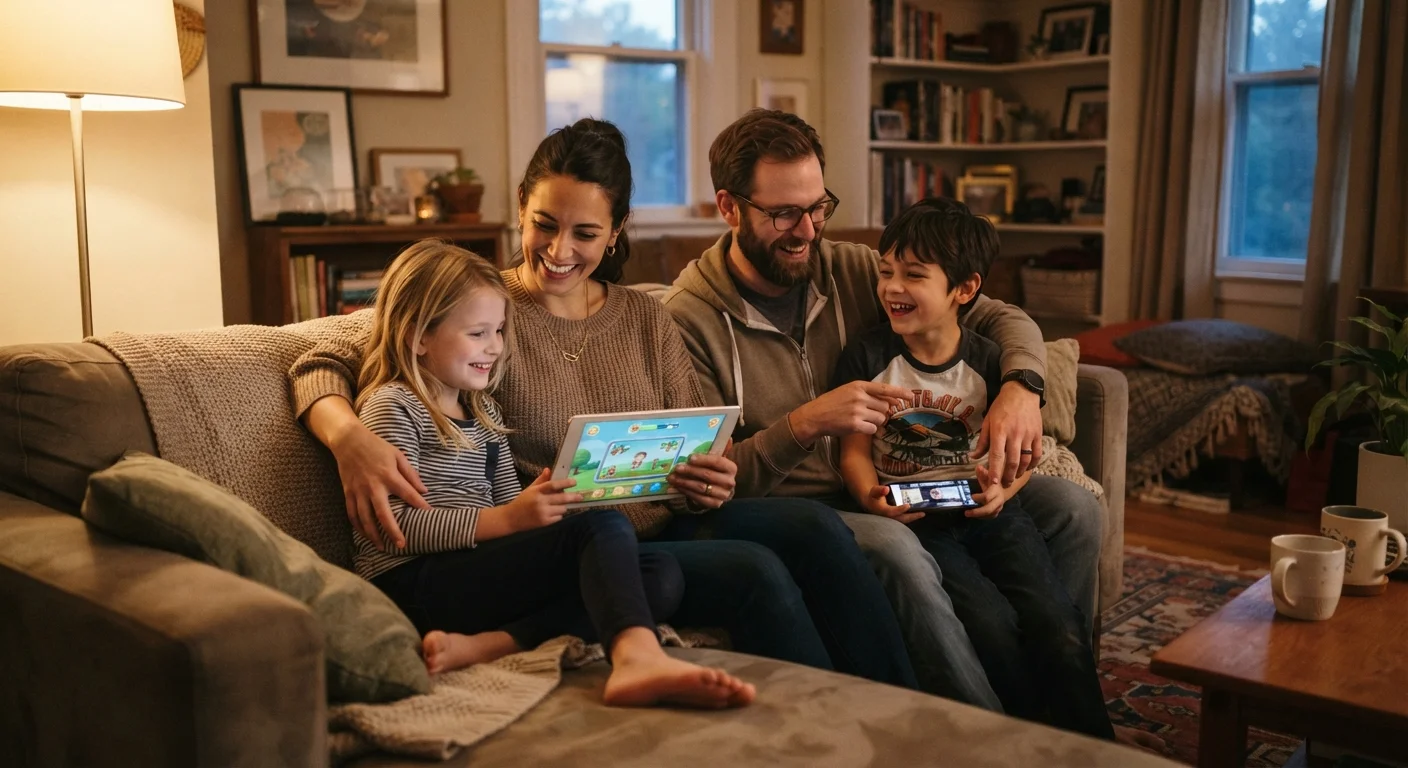
Finally, co-viewing matters. When parents watch or play alongside their children - commenting, asking questions, connecting content to real life - the developmental profile of that screen time changes substantially compared to unaccompanied consumption.
Building Habits That Fit Your Family
No universal rule fits every household. A one-size limit ignores differences in age, content, household structure, and a child's individual needs. That said, a few broadly supported practices are worth considering:
- Keep screens out of bedrooms at least an hour before sleep, especially for children and teens.
- Make mealtimes and outdoor play reliably screen-free by household norm, not crisis-by-crisis negotiation.
- Watch or play alongside younger children regularly - not to police content, but to engage with it together.
- Check in periodically on how your child feels after screen time, not just how long they spent on it.
For complementary context on how outdoor time benefits family wellbeing, our guide to outdoor time as a family wellness tool offers practical, evidence-informed suggestions. And if screen habits seem to be affecting your child's mood or mental health, our resource on starting mental health conversations at home can help open that dialogue.
This article is for general informational and educational purposes only and is not a substitute for professional medical or psychological advice. Consult a qualified healthcare provider for guidance specific to your child or family's circumstances.