
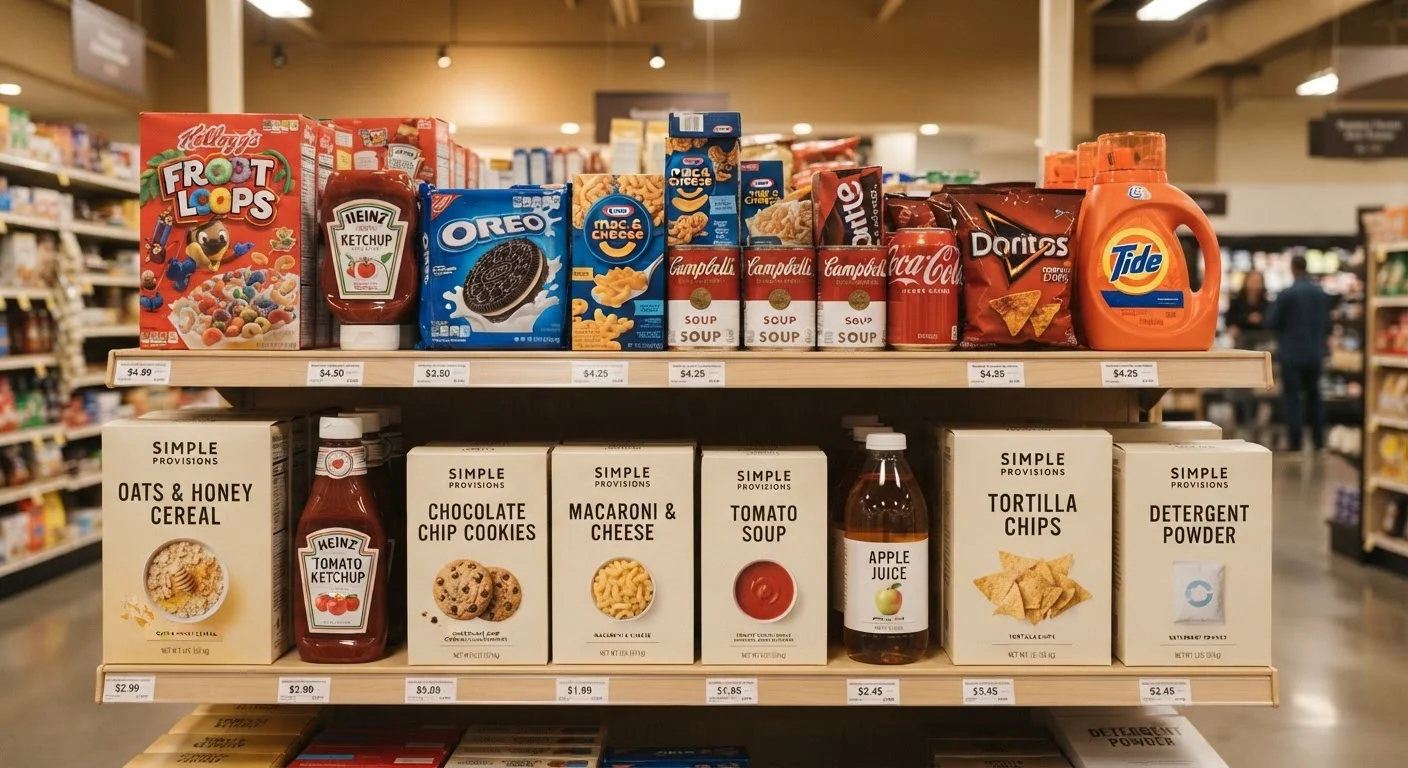
The Brand Premium: What You're Really Paying For
Walk down any grocery or pharmacy aisle and you'll notice a consistent pattern: the name-brand product and the store-brand equivalent sit side by side, often with a 20–40% price difference between them. Most shoppers instinctively assume that gap reflects a quality difference. Research suggests that assumption is far more complicated than it appears.
A significant portion of the brand-name premium funds marketing, packaging design, and advertising budgets — not formulation or manufacturing improvements. National brands spend heavily to build familiarity and trust, and that spend is baked into the price consumers pay at the register. Understanding this dynamic is the starting point for making smarter purchase decisions.
For a broader lens on evaluating what price signals actually mean, see our guide to evaluating real value — it applies the same critical framework across product categories.
Myth
Name-brand products are always made to a higher standard than store brands.
Fact
Many store-brand products are manufactured in the same facilities as national brands, sometimes on the same production line.
Contract manufacturing is common across food, household goods, and personal care categories. A retailer may source a private-label product from the exact same supplier that produces the leading national brand. The label changes; the factory and formulation often don't. Independent reporting and industry insiders have documented this practice widely, particularly in grocery and pharmacy categories.
Myth
Generic medications are weaker or less effective than brand-name drugs.
Fact
In the United States, the FDA requires generic drugs to contain the same active ingredient, strength, and dosage form as brand-name equivalents.
Generic drugs must demonstrate bioequivalence to the original — meaning they are absorbed by the body at the same rate and to the same extent. The differences that do exist involve inactive ingredients like binders or colorants, which rarely affect therapeutic outcomes for most people. Consulting a pharmacist or physician is always appropriate if you have specific concerns about switching.
Myth
If a store brand is significantly cheaper, there must be a hidden trade-off in quality.
Fact
The price difference often reflects lower marketing and advertising spend by the retailer, not a reduction in manufacturing quality.
National brands invest heavily in television advertising, sponsorships, and shelf placement fees — costs that get passed on to consumers. Store brands skip most of that spending. When the underlying product is comparable, the savings consumers see at the register represent the marketing budget they're no longer subsidizing. That said, it's still wise to check ingredient lists and independent reviews rather than assuming equivalence without verification.
Myth
Blind taste tests always favor name-brand foods.
Fact
Consumer research consistently shows that taste-test participants frequently cannot distinguish store-brand staples from national-brand equivalents, and sometimes prefer the store brand.
Multiple consumer organizations have conducted blind taste-panel studies on common grocery items — canned goods, cereals, condiments, and dairy products. The results regularly show that preference differences are small or statistically insignificant for many staple categories. When a recognizable logo is removed from the equation, the perceived quality gap tends to narrow or disappear entirely. This doesn't mean every store brand wins — but it does challenge the assumption that a familiar label guarantees a better product.
Myth
Switching to store brands is only worth it for low-importance purchases.
Fact
Some of the highest-value switches involve everyday essentials — medications, pantry staples, and cleaning supplies — categories where store brands routinely match performance standards.
The misconception that store brands are only appropriate for trivial purchases can cost households meaningful money over time. A family switching over-the-counter pain relievers, allergy medications, and pantry staples to store-brand equivalents can generate consistent savings without a measurable change in experience. The key is to evaluate each category rather than applying a blanket rule in either direction. For broader nutritional context on food categories, see our overview of whole foods vs. processed foods.
Where the Differences Are Real — and Where They Aren't
Research doesn't support a blanket verdict in either direction. The honest answer is: it depends on the category.
~25–30%
Typical price gap between name brands and store brands
Industry analyses consistently estimate store brands price at roughly 25–30% less than comparable national brand products on average.
~40%
Share of U.S. grocery unit sales from store brands
Private label goods have grown steadily as a share of U.S. grocery sales, reflecting increasing consumer willingness to consider store-brand alternatives.
In regulated categories like over-the-counter medications, the FDA requires generic and store-brand drugs to contain the same active ingredients, concentration, and dosage form as their brand-name counterparts. Here, the quality equivalence is legally mandated, not just likely. The differences are typically limited to inactive ingredients like fillers or dyes, which rarely affect outcomes for most consumers.
Packaged staple foods — canned tomatoes, all-purpose flour, dried pasta — tell a similar story. Consumer research has repeatedly found that taste-test panels struggle to distinguish store-brand staples from name-brand equivalents under blind conditions. In some cases, private-label products score higher. This isn't a coincidence: many store brands are manufactured in the same facilities as the national brands they sit beside on the shelf.
The picture shifts in a few specific areas. Some product categories do show consistent quality differences — certain electronics, specialized tools, and complex formulations where proprietary research genuinely differentiates a product. For guidance on reading those differences accurately, our quality signals explainer breaks down what to look for across categories.
Don't Assume Equivalence Without Checking
While many store brands match their name-brand counterparts, this isn't universal. For complex products — skincare formulations, electronic components, or specialized tools — ingredients, materials, and construction can differ in ways that affect performance or longevity. Check ingredient lists, look for independent reviews, and when in doubt, try a single unit before committing to a large purchase.
Fashion and apparel follow a different logic altogether — branding often signals status rather than construction quality. For a parallel breakdown in that space, see fast fashion vs. slow fashion, which examines how price and quality interact in clothing.
Building a Category-by-Category Approach
The most practical takeaway from the research isn't a single rule — it's a habit. Rather than defaulting to either name brands or store brands across the board, evaluate each category on its own terms.
A useful starting framework:
- Regulated products (medications, supplements): Store brands meeting the same regulatory standards are typically equivalent. Check the active ingredient list to confirm.
- Staple foods and pantry items: Store brands perform well in blind comparisons. Taste one before committing to a full switch.
- Complex electronics or specialized equipment: Look at independent reviews and objective quality indicators rather than brand name alone.
- Bulk staples: Store brands bought in volume can amplify savings significantly. Our bulk-buying guide explains when the math actually works.
Brand loyalty isn't irrational — familiarity has real value when a product consistently meets your needs. But when that loyalty is driven more by habit or advertising than by a genuine performance difference you can identify, it's worth testing the alternative. Your findings may surprise you.
This article is for general informational purposes only and does not constitute financial, medical, or professional advice. Readers should consult qualified professionals for decisions specific to their circumstances.