
The Gap Between What You Think Is Covered and What Actually Is
Most people buy an insurance policy, file it away, and assume they're protected - until a claim comes back denied. That gap between expectation and reality almost always traces to policy language that was there the whole time, just unread.
Insurance policies are contracts. They spell out exactly which losses the insurer agrees to pay, under what conditions, and what is explicitly off the table. Insurers deny claims not out of arbitrary judgment but because the event being claimed either falls outside those agreed terms or because the policyholder failed to meet a procedural requirement. Understanding both categories puts you in a much stronger position before you ever need to file. For a plain-language breakdown of the terms you'll encounter, see our claims glossary.
~18%
Health insurance claims denied in the individual market
According to a KFF analysis of ACA marketplace insurer data, roughly 1 in 6 in-network claims were denied - though denial rates varied widely by insurer.
< 0.2%
Denied health claims formally appealed by patients
The same KFF analysis found that the vast majority of policyholders do not appeal denials, leaving many potentially reversible decisions unchallenged.
40%+
Appealed health denials overturned in consumer's favor
State insurance department data consistently show that a meaningful share of internal appeals succeed, underscoring the value of challenging a denial.
The Most Common Reasons Insurers Cite for Denials
Exclusions. Every policy contains an exclusions section - a list of events, causes, or property types the policy does not cover. Standard homeowners policies, for example, typically exclude flood damage. Standard health plans may exclude certain elective procedures. If your loss matches an exclusion, the insurer will cite it by name in the denial letter.
Lapsed or inactive coverage. If a premium payment was missed and the policy lapsed before the loss occurred, there is no active contract to pay under. Even a brief gap can be consequential. This is distinct from a deductible - the common misunderstandings about deductibles are a separate issue from whether coverage was active at all.
Late filing. Policies require that losses be reported within a specified window - sometimes as short as 30 days. Missing that deadline gives the insurer grounds to deny, even for an otherwise covered loss.
Misrepresentation on the application. If information provided when you applied - about your health history, home condition, or driving record - turns out to be inaccurate, the insurer may argue the policy was issued under false premises. This can void coverage retroactively.
Insufficient documentation. A claim requires proof: receipts, photos, police reports, medical records. If the documentation doesn't support the claimed loss, the insurer may deny until adequate proof is provided.
Read the Exclusions Section Before You Need It
Set aside 20 minutes when you receive or renew any policy to read the exclusions section start to finish. Flag any exclusion that applies to a realistic risk in your life - a basement, a home business, an older car. If something isn't covered that you assumed was, you still have time to ask your insurer about adding an endorsement or purchasing separate coverage.
What the Fine Print Actually Says - and Where to Find It
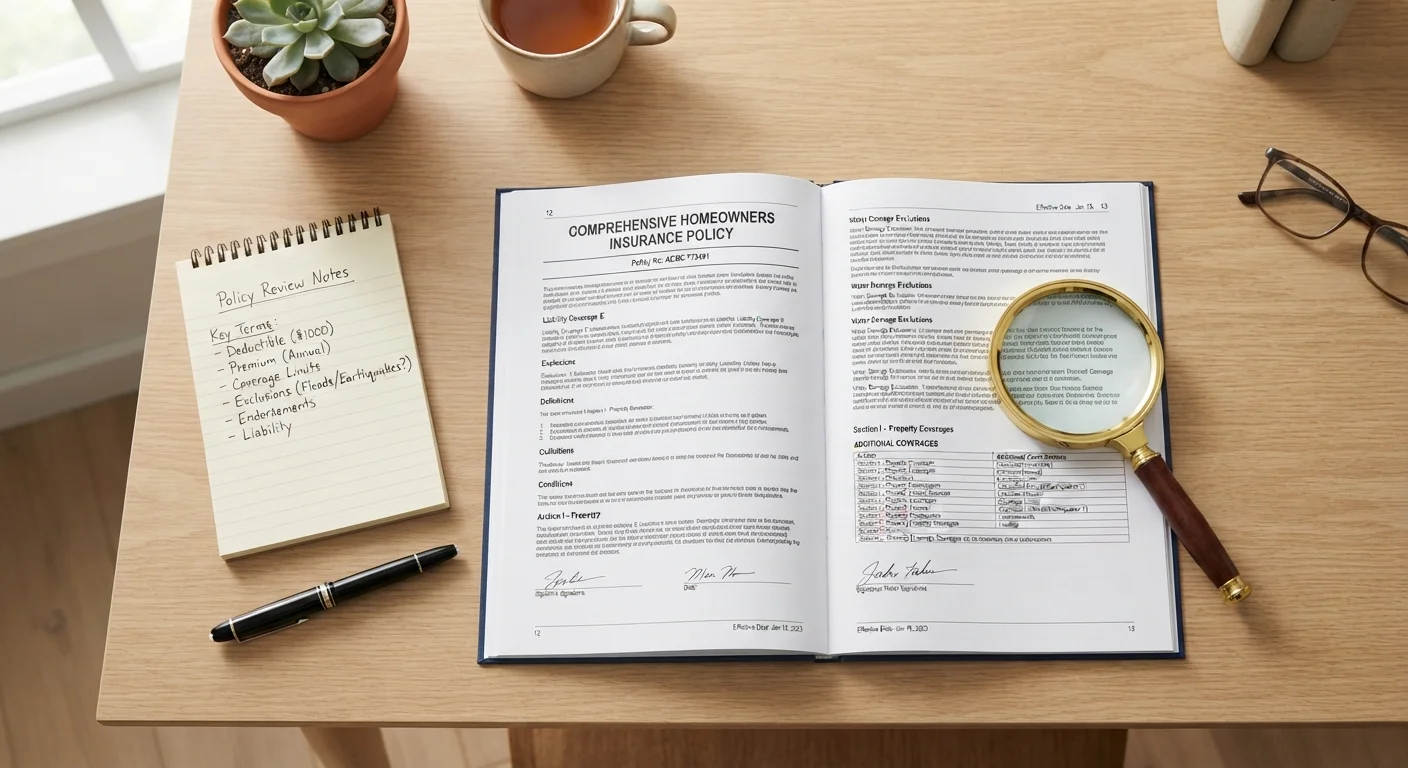
The most consequential sections of any policy are the declarations page, the definitions section, and the exclusions section. The declarations page summarizes what you bought - coverage types and limits. The definitions section controls how terms like occurrence, dwelling, or bodily injury are interpreted. The exclusions section lists what is not covered, often in dense, clause-heavy language.
A practical habit: when you receive or renew a policy, search the document for the word "excluding" or "we will not pay." These phrases flag the denial risks most relevant to your situation. If your coverage limits themselves are a concern - not just the exclusions - the issue of underinsurance is worth understanding separately.
This article is for general informational purposes only and does not constitute insurance, legal, or financial advice. Coverage terms, exclusions, and regulations vary by policy and state. Consult a licensed insurance professional and review your actual policy documents for guidance specific to your situation.