Three Services, Three Different Problems
Walk into almost any tire shop and you'll see rotation, balancing, and alignment listed side by side on the service menu. They sound related - and they all involve your tires - but each one targets a fundamentally different issue. Mixing them up, or assuming one covers another, can leave real problems unaddressed while you pay for services you may not need.
Understanding what each service actually does puts you in a much stronger position when a service advisor recommends one. It's a core part of being an informed car owner - something covered more broadly in the Car Ownership Basics hub.
~$0.11/mile
Estimated tire cost per mile when worn prematurely
Industry estimates suggest improper tire maintenance - skipped rotations, misalignment - can cut tire life by 25% or more, increasing the effective per-mile cost significantly.
5,000-7,500 mi
Typical recommended tire rotation interval
Most vehicle manufacturers and tire producers recommend rotation within this range; always confirm with your specific owner's manual.
~1/4 inch
Toe misalignment that can cause significant wear
Even small deviations in toe angle - as little as a quarter inch off spec - can cause a tire to scrub sideways across the pavement with every mile driven.
Tire Rotation: Equalizing the Wear
Every tire on your vehicle works differently depending on where it sits. On a front-wheel-drive car, the front tires handle acceleration, steering, and a large share of braking - they wear faster than the rear tires. On rear-wheel-drive vehicles, the opposite is often true. Even all-wheel-drive systems don't distribute forces perfectly evenly.
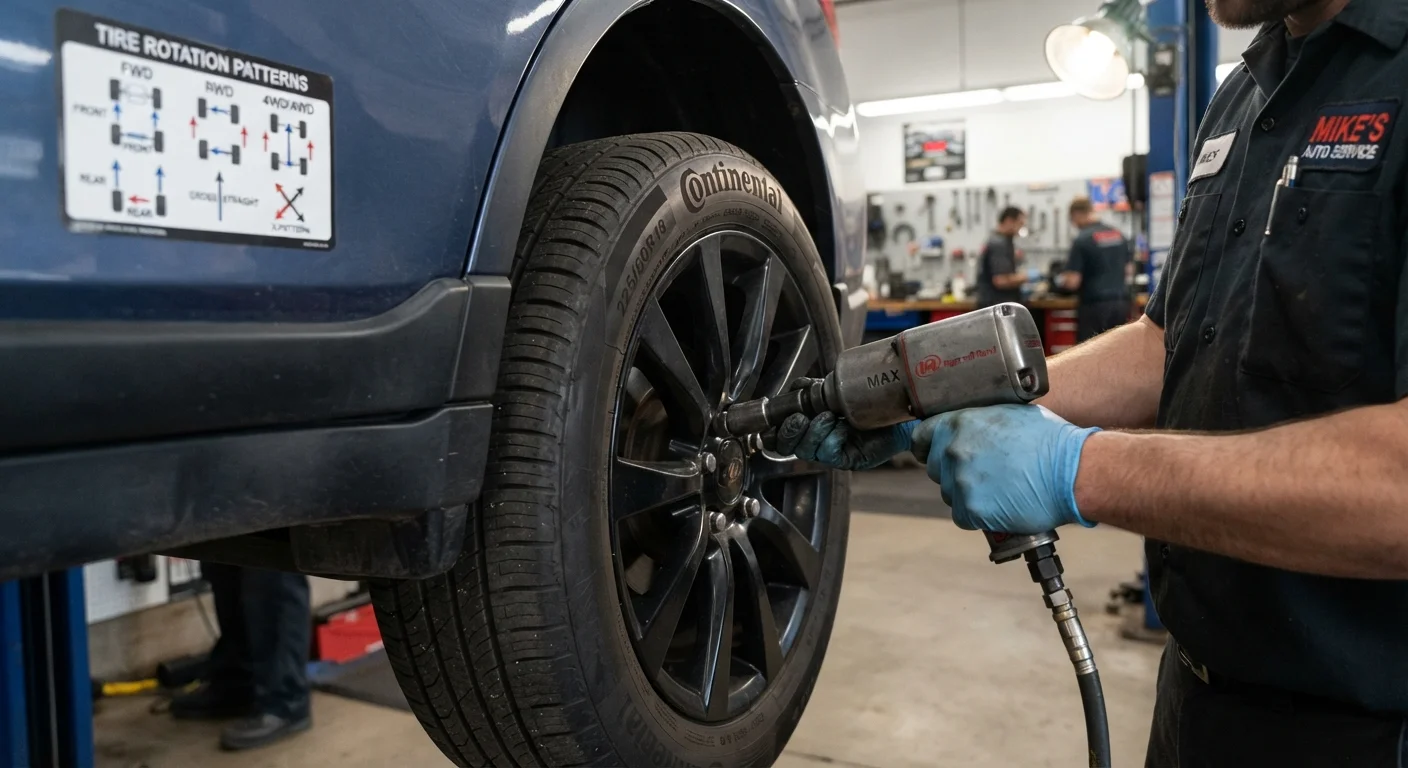
Rotation moves each tire to a different position - typically swapping front to rear and side to side according to a pattern suited to your drivetrain - so that no single tire carries a disproportionate workload over time. The goal is to maximize the useful life of the full set.
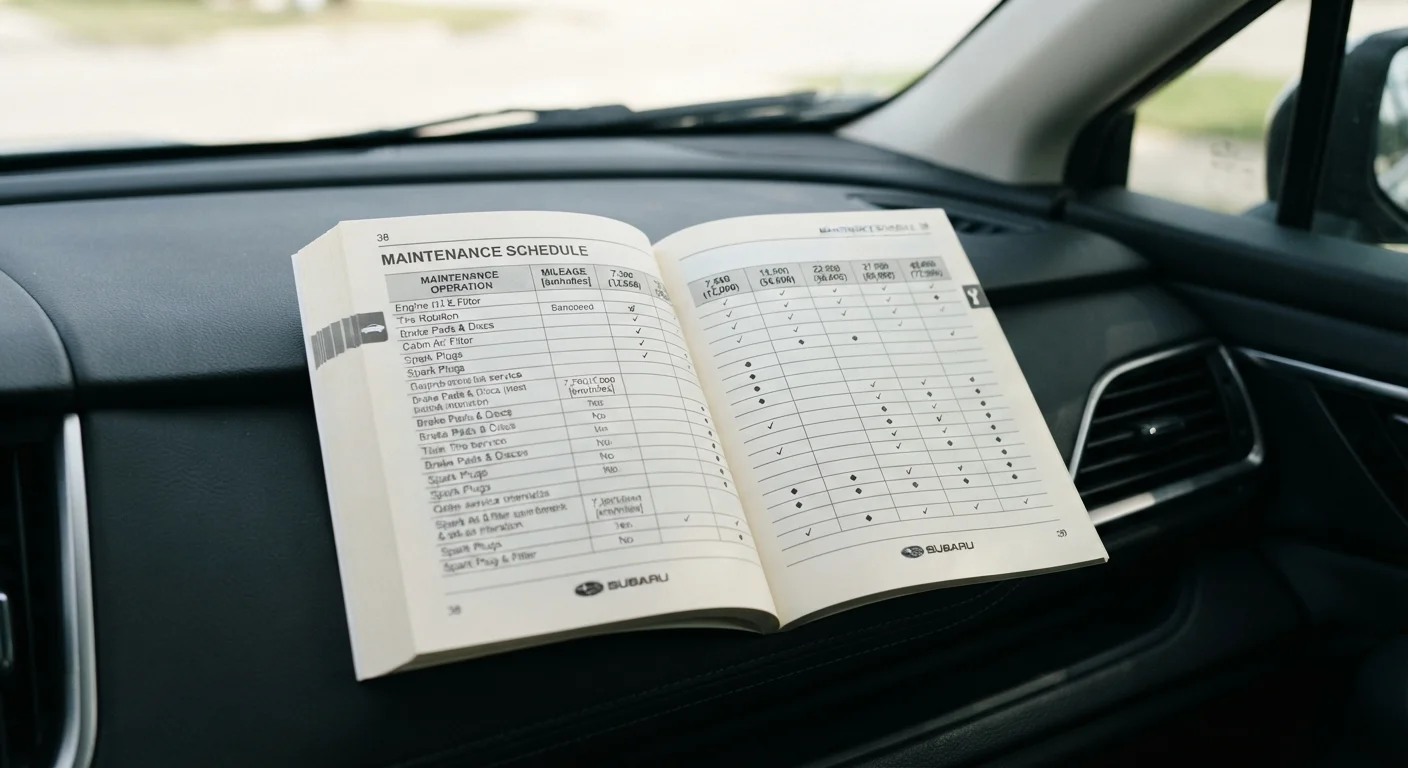
Most vehicle manufacturers recommend rotating tires every 5,000 to 7,500 miles, which conveniently aligns with many oil change intervals. Your owner's manual is the authoritative source for your specific vehicle. For a broader look at how rotation fits into your overall service plan, see Your Car's Maintenance Schedule, Explained.
Unusual wear patterns - cupping, feathering, or one-sided wear - can signal that rotation alone won't solve the problem. Tire Wear Patterns and What They're Telling You offers a useful guide to reading those signs.
Wheel Balancing: Smoothing Out the Vibration
A tire and wheel assembly is never perfectly uniform in weight. Small variations in the rubber, the wheel casting, or even valve stem placement create tiny imbalances. At low speeds these are imperceptible, but at highway speeds they cause the assembly to wobble slightly, producing vibration you'll feel in the steering wheel, the seat, or the floorboard.
Balancing corrects this by attaching small weights to the wheel rim at specific points identified by a computerized spin-balance machine. The result is a smoother ride and less stress on wheel bearings and suspension components.
Check for Vibration at Highway Speed
If you notice a new vibration at speeds above 50-60 mph that wasn't there before, balancing is a logical first step to investigate. Describe exactly when the vibration occurs - speed range, whether it's in the wheel or seat - so your mechanic can narrow down the cause efficiently. Not all vibrations are balance-related; worn suspension components can produce similar symptoms.
Balancing is typically needed when tires are first mounted, after a significant road impact (a hard pothole or curb strike), or whenever persistent vibration appears. It isn't tied to a strict mileage interval the way rotation is. Some shops include a balance check at every rotation; others treat it as a separate service. Ask what's included before you agree to a service package.
Wheel Alignment: Pointing in the Right Direction
Alignment has nothing to do with the weight distribution inside a tire. Instead, it refers to the precise angles at which your wheels contact the road - settings adjusted at the suspension, not the tire itself. Three primary angles matter: toe (whether tires point slightly inward or outward when viewed from above), camber (tilt inward or outward when viewed from the front), and caster (the steering axis angle viewed from the side).
When these angles drift out of specification - due to a hard impact, worn suspension parts, or simply accumulated use - the vehicle may pull to one side, the steering wheel may sit off-center, or tires will wear unevenly on one edge. Left uncorrected, misalignment accelerates tire wear significantly and can place stress on other suspension components.
Alignment should be checked after any significant impact, after suspension or steering repairs, and any time you notice pulling or uneven wear. Many mechanics suggest an annual check as a baseline. Seasonal Car Care is a natural time to include this check, particularly before winter driving.
If you're deciding where to have alignment work done, Independent Mechanic vs. Dealership Service Department breaks down the structural differences between your options to help you choose what fits your situation.
How These Services Work Together
None of these services replaces another. A well-balanced tire on a misaligned vehicle will still wear unevenly. A properly aligned vehicle with tires that haven't been rotated will still see uneven wear across the axles. Think of each as addressing a different layer of the same system.
The practical takeaway: don't assume that because you had one service done recently, the others are covered. Keep a simple record of when each was last performed - many maintenance apps or a note in your glove box will do. And consult Car Maintenance Intervals That Actually Matter for a broader perspective on which milestones deserve your attention and when.
This article provides general vehicle maintenance information for educational purposes. For guidance specific to your vehicle, consult your owner's manual or a qualified mechanic.